


As Turkey Courts Ocalan, an Old Kurdish Ally Finds Itself on the Outside
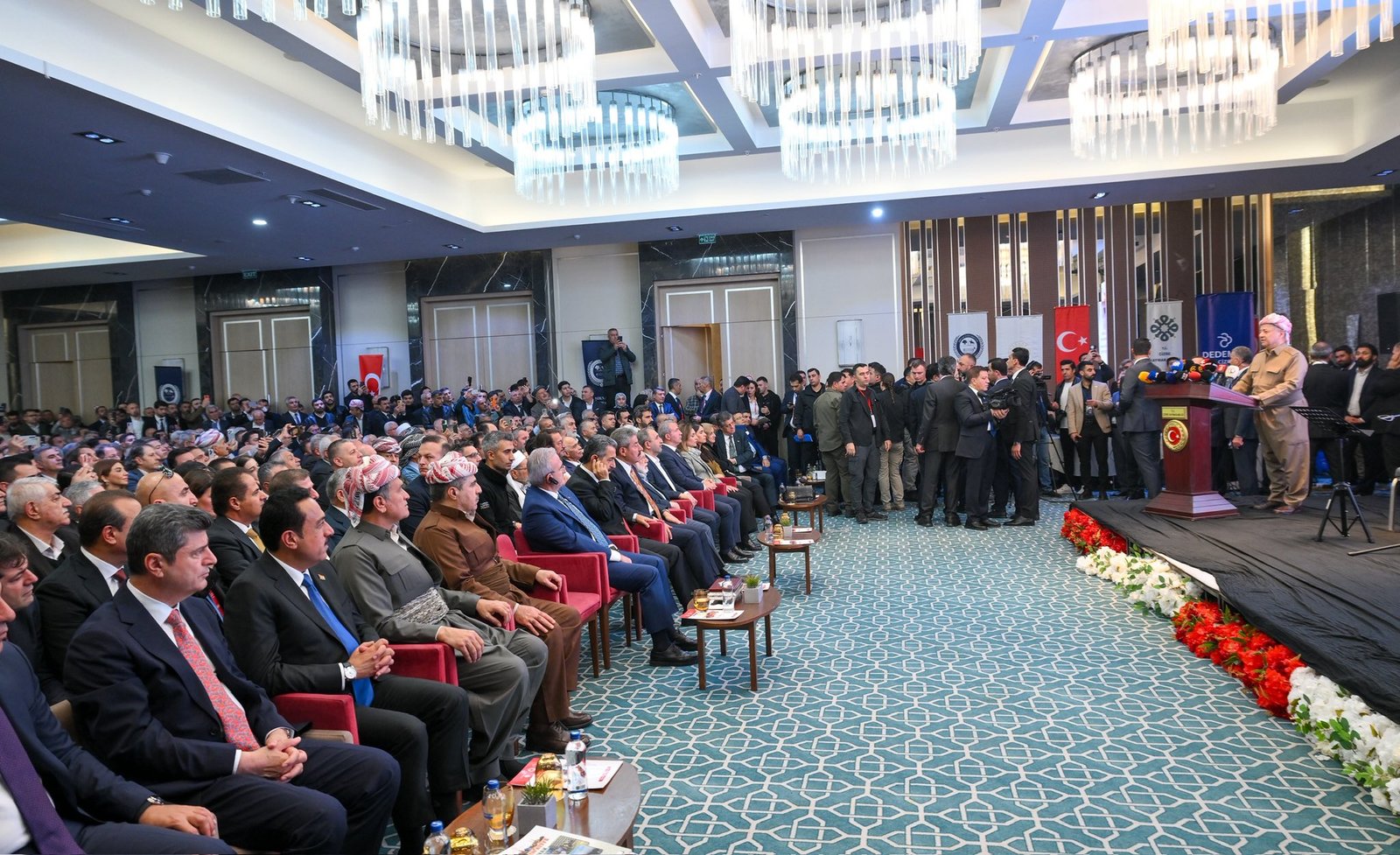
Masoud Barzani’s weekend visit to Turkey’s Kurdish border province of Sirnak has triggered an unusually public confrontation between his office and Turkey’s leading nationalist politician, Erdogan ally Devlet Bahceli, exposing the fault lines inside Turkey’s tentative peace initiative with Abdullah Ocalan.
Context: On the surface, the incident looked minor. During Barzani’s appearance at the local university, one of his bodyguards, dressed in a Peshmerga-style uniform and carrying an M4-type rifle, was filmed as members of the crowd chanted “Long live Peshmerga.” The clip went viral on Turkish and Kurdish social media. What followed was anything but minor.
Devlet Bahceli, leader of the Nationalist Movement Party (MHP) and the most visible political face of Ankara’s new engagement with Ocalan, denounced the scene in an interview with the pro-MHP daily Turkgun. He called it “a disgrace” that “foreign-uniformed soldiers” with long-barrelled weapons were “wandering around our homeland,” casting the episode as a violation of Turkish sovereignty.
Barzani’s headquarters responded with unexpected ferocity. In a sharply worded statement, it insisted all security arrangements had been pre-coordinated with Turkish authorities, then turned personal, accusing Bahceli of chauvinism and saying they had believed “God had guided” him away from racism, only to find he was still “the same old Grey Wolf, only now in sheep’s clothing.”
The Turkish state apparatus quickly closed ranks around Bahceli. The foreign ministry condemned the Barzani office text as “unacceptable with regard to both substance and the language used” and demanded clarification and “immediate action” against those responsible. AKP spokesperson Omer Celik warned that such rhetoric “harms the process of establishing a terror-free zone.” President Erdogan himself called the statement “impertinent” and said it had to be corrected. Officially, Ankara has framed the episode as a “spokesperson problem,” implying an overstep by Barzani’s staff rather than a rupture with Barzani personally.
But the timing, days after a historic parliamentary visit to Ocalan on Imrali, makes the episode politically loaded.
Analysis: Barzani’s presence in Sirnak at this particular moment is itself unusual. Since the 2017 independence referendum, Masoud Barzani as an individual has had almost no direct political or diplomatic contact with Ankara, especially with Erdogan. Relations between the KDP and Turkey have largely been handled through Nechirvan Barzani. For Masoud Barzani to reappear on Turkish soil in such a symbolic Kurdish city, with television cameras and bodyguards clearly visible, is therefore not a routine event.
There is little doubt that Barzani’s trip to Sirnak – and that of his bodyguards – took place within a protocol agreed in advance by Turkey’s security establishment: the intelligence agency MIT, the gendarmerie and the interior ministry. The audience that was allowed to attend and film was also presumably vetted. These visits are typically choreographed down to the smallest detail. What seems more likely is that Bahceli’s camp was not fully briefed on those details, including the Peshmerga-style uniforms and flags on the bodyguards’ shoulders. This goes some way to explaining the ferocity of his reaction.

The incident can be read through two lenses, one focused on intra-alliance dynamics, the other on a deeper strategic realignment.
If one reads Bahceli’s full statement, his criticism was directed as much at the security apparatus – and by implication at Erdogan – as at Barzani. There was no personal attack on Barzani himself. What was surprising was the Barzani office’s response: fierce, personal, and designed to burn bridges with Bahceli specifically. That response turned what could have been a minor protocol embarrassment into a political rupture. For a camp that has always treated the Turkish state with careful deference, this is highly atypical.
To understand why this matters, one must understand the dynamics currently shaping the peace process. Bahceli has been its public champion. Erdogan has not. The president has kept one foot on the brake throughout, never fully committing, never clearly endorsing even basic steps. His language has been cautious, his support equivocal. Even over the specific question of allowing a parliamentary delegation to visit Ocalan – a step that, until recently, was politically unthinkable in Turkey – he avoided giving clear public backing. By most accounts, he was not enthusiastic about it.
For weeks, Bahceli pushed hard for the visit, framing it as a necessary step for the parliamentary commission on “social peace.” Erdogan dragged his feet. After a series of meetings between the two leaders, the issue still appeared unresolved. Bahceli then upped the stakes by declaring that if the parliamentary commission did not go to Imrali, he would go himself. This effectively forced Erdogan to choose: either block the visit and risk a rupture with his most crucial ally, or allow it and be seen as following Bahceli’s lead on a sensitive Kurdish file.
This is the context: Bahceli is now an essential pillar of the ruling alliance. Without the MHP, the governing coalition becomes numerically fragile and politically exposed. Erdogan cannot easily discard him. But if he wished to cause Bahceli a headache – to take indirect revenge for having his hand forced – engineering an incident that embarrasses Bahceli without Erdogan’s fingerprints on it would be one way to do so.
The Sirnak visit fits that pattern. A protocol arranged entirely by Erdogan’s security apparatus. Bahceli kept in the dark. A viral clip that provokes a nationalist reaction. And then a statement from Barzani’s office that attacks Bahceli personally.
There is another detail worth noting. At the same Sirnak event, AKP MP Arslan Tatar – an Erdogan ally – showered praise on Barzani in terms that also went viral. The remarks appeared designed not merely to flatter Barzani but to serve as an implicit jab at Ocalan, who now leads the Kurdish side in the peace process. In other words, Barzani is symbolically rehabilitated on Turkish soil just as Ocalan gains formal recognition through a parliamentary visit.
Whether this interpretation ultimately holds is an open question. It is plausible, given the timing, the choreography and the internal tensions over Imrali, but it is not the only explanation. It is equally possible that this was an overconfident attempt to be cordial to Barzani that spiralled once Bahceli reacted – and that the Barzani office’s unusually harsh statement was driven more by wounded pride than by any deeper script. The KDP may simply have misjudged the moment: not fully grasping how central Bahceli has become to Erdogan’s political survival, or how personally invested Bahceli is in the peace process he has staked his legacy on. Insulting the man who broke a decades-long nationalist taboo to shake hands with DEM politicians and call for dialogue with Ocalan was, at minimum, a strategic miscalculation – whether or not it was prompted by anyone in Ankara.
But there is a second, perhaps more consequential lens through which to view this episode.
At first glance, this looks like a protocol spat that got out of hand. In reality it captures a larger strategic shift: as Ankara moves toward a structured settlement with Ocalan’s world, the KDP is being pushed from the centre of Turkey’s Kurdish strategy to its edge. And this is exposing the ideological mismatch between Barzani’s project and the one now emerging between Ankara and Imrali.
The KDP’s language is nationalist and traditional. Its legitimacy rests on the idea of a distinct Kurdish nation, symbolised by its own flag, its own Peshmerga forces and, in 2017, its own independence referendum. Politics is organised as a state-building story, with the Barzani family as the guardian of a territorial Kurdish entity. In that frame, a Peshmerga bodyguard in uniform on Turkish soil, greeted with chants of “Long live Peshmerga,” is not just a security detail. It is a projection of that state-building narrative across the border.
This creates an awkward position for Barzani. For years, the KDP was Turkey’s preferred Kurdish partner precisely because it was not the PKK. Ankara could do business with Erbil – oil deals, military cooperation against PKK bases, trade – without having to engage Ocalan or legitimise his movement. But now that Ankara is engaging Ocalan directly, the KDP’s utility diminishes. Worse, its nationalist symbolism becomes a liability. If Turkey is trying to sell its own Kurdish population on a settlement that emphasises unity and integration, the last thing it needs is images of uniformed Peshmerga in Cizre reminding everyone that another model – a separate Kurdish armed identity – exists just across the border.
Barzani’s visit, in this light, was not just poorly timed. It was structurally discordant with the political moment. And the harshness of his office’s response to Bahceli – the man who has done more than anyone to legitimise the new process – may reflect not just bruised ego but a dawning recognition that the ground is shifting beneath the KDP’s feet.
What is clear is that a seemingly minor protocol issue in Sirnak has become a stress test for Turkey’s new Kurdish opening, revealing how fragile the coalition behind the peace process still is – and how the regional Kurdish landscape is being quietly reordered as Ankara and Imrali move closer together.


