


Turkey’s PKK Framework Law Sets a Controlled First Stage in a Wider Regional Project
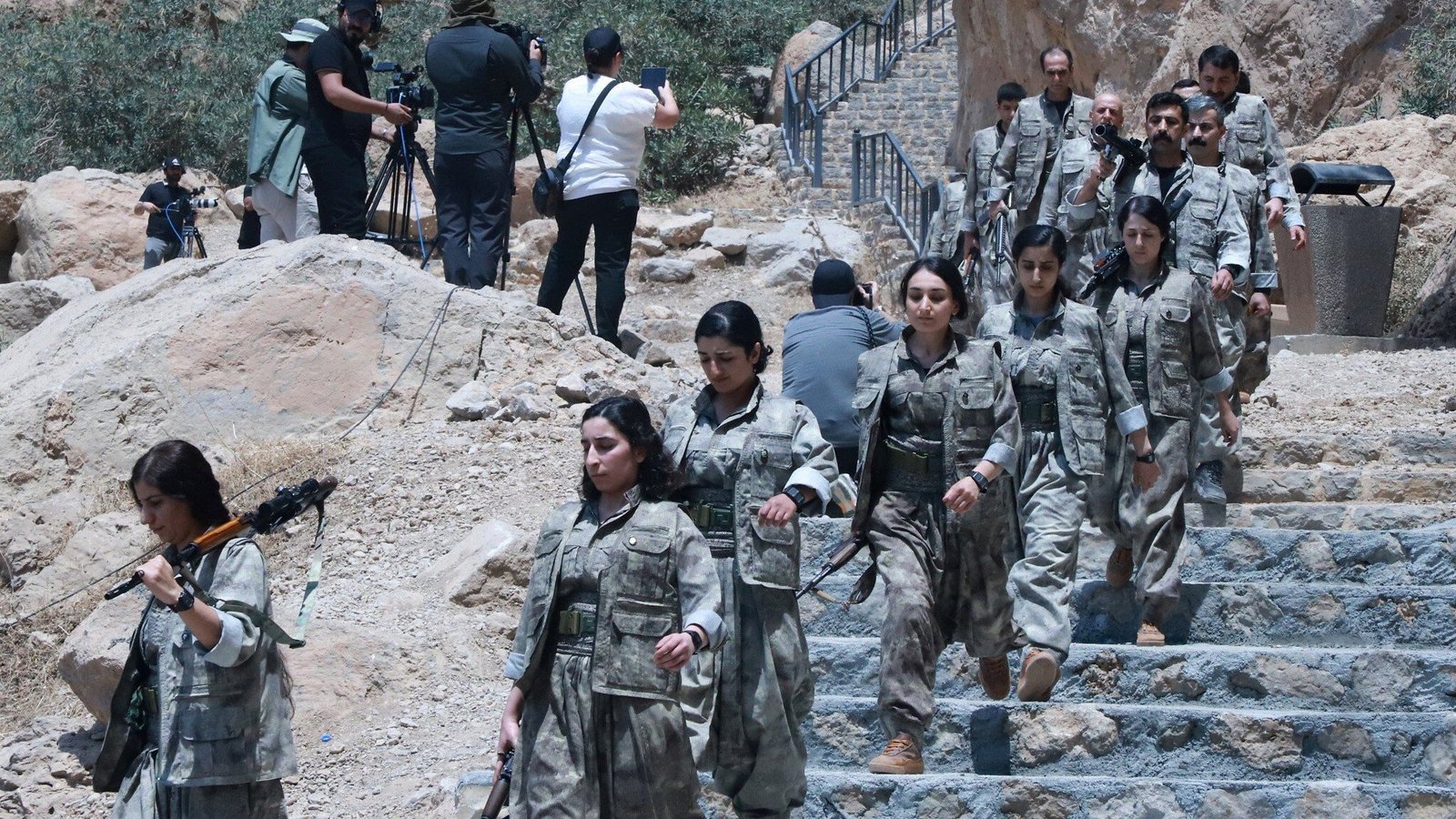
Parliament is expected to pass the 12-article law governing the PKK’s dissolution within days. Its provisions are narrow, tightly sequenced and placed under state control at every stage, while the project built around it extends well beyond Turkey’s borders.
Turkey’s framework law for the PKK’s dissolution was opened for signatures in parliament on Tuesday. MHP leader Devlet Bahceli was among the first to sign, and AK Party representatives held final consultations with DEM Party lawyers and MPs. The proposal, formally titled the Law on Strengthening National Solidarity and Social Integration, is expected to reach the Speaker’s office on Wednesday, pass through the Justice Commission on Friday and come to a General Assembly vote before the weekend ends, ahead of the summer recess. Every parliamentary party except the Iyi Party is expected to support it. CHP leader Kemal Kilicdaroglu announced his backing at a press conference this week, while Ozgur Ozel, leader of breakaway New Party which commands most CHP MPs, has said his party considers itself part of the process despite the government, and the Yeni Yol group is expected to take the same position.
The full text had not been published in the parliamentary database as of Tuesday evening. The known provisions rest on briefings to Turkish media and statements from the parties involved.
The law contains no general amnesty and no article on Abdullah Ocalan’s legal status. PKK members seeking to benefit would apply within a six-month window that opens only after the state formally verifies that the organisation has dissolved and abandoned its weapons irreversibly. As TNC has reported, that verification runs through the security establishment’s certification of conditions on the ground. Offences committed before 2005 that carry life or aggravated life sentences would remain outside the framework. Other cases enter a system of conditional suspension: proceedings or sentences below 15 years are suspended for five years, those above 15 years for ten. Compliance across that period leads to the case or sentence being dropped. Whether suspension leaves the conviction intact or extinguishes the prosecution entirely will only become clear from the official text, and the two readings carry different political consequences. The practical formula offers immediate physical freedom followed by delayed legal rehabilitation, with returnees under supervision and subject to legal and political restrictions for five or ten years.
Two bodies would oversee the process. An executive board chaired by Vice President Cevdet Yilmaz, including ministers and the relevant state institutions, supervises disarmament, dissolution and the return process. A Monitoring and Liaison Board inside parliament, with representatives of the political parties, provides a continuing channel between the government, parliament and the parties managing the process. Some provisions enter into force immediately; others activate only after verification. Sequencing therefore sits with the state at every stage: Ankara determines whether disarmament has occurred, when the application window opens, who qualifies and whether individuals have complied. The Presidency’s Communications Directorate described the proposal as an expression of state determination and identified the irreversible abandonment of weapons as the immediate priority.
Context: The deliberation that produced the text largely preceded its submission. The parliamentary commission spent months preparing the report on which the law rests, and the substance was negotiated privately among the AK Party leadership, MHP officials including Feti Yildiz, DEM representatives and Ocalan’s lawyers, and the executive and security institutions.
The final week reshaped parts of the arrangement. The understanding reached between state institutions and Ocalan was revised by the AK Party, reportedly at President Erdogan’s initiative, with the question of whether returnees would face restrictions on political activity among the contested points. The Imrali delegation – made of pro-Kurdish Dem party MPs – then met Ocalan for three hours over the weekend, after which a new understanding emerged. Ocalan appears to have set aside the demand that all sections of the organisation be included simultaneously and accepted a phased transition.
His statement, issued through the delegation on Monday, called the law the key that opens the way for the process and said the door of a democratic republic is being opened wide, while acknowledging that the legislation falls short of some expectations. The message was addressed as much to Qandil, the organisation’s European structures and its prisoners as to the Turkish public. Expectations across the movement are high, and its discipline on this question rests on Ocalan’s personal authority; the prevailing attitude in Qandil is that if he opens a path, the organisation will follow it. He is expected to explain the decisions to his own constituency directly, possibly through the media, and to offer assurances to audiences beyond his base.
The compressed timetable is procedurally permissible. The 48-hour waiting period before commission consideration can be waived on the recommendation of the Conference of Group Representatives, and the second 48-hour period before the General Assembly can be waived on a request for urgency. Parliament can also sit at the weekend. There is precedent for the pace: the tenth judicial package in 2025 moved from submission to enactment in six calendar days. What distinguishes this case is the combination of speed, consequence and restricted access to the text. MPs were briefed orally while the draft circulated among the negotiating parties, and it remained absent from the legislative database on the eve of submission. The parliamentary stage formalises an agreement concluded elsewhere. The speed serves several calculations at once: it preserves momentum, completes the first legal stage before the recess so that returns and verification can begin, and defers the harder constitutional questions to later packages.
Analysis: The law’s narrowness reflects the design of a multi-stage process. The commission’s report presented itself as a road map and separated the immediate legal framework from a later section on democratisation. Ocalan has used the same sequencing language.
The process runs at two speeds. Individual reintegration is slow: fighters can return relatively quickly, but full legal and political rehabilitation takes five or ten years. The collective incorporation of the Kurdish political movement is already moving faster. DEM negotiated the law, will sit on the parliamentary monitoring board and has become a routine interlocutor for the government and the MHP. The parliamentary arithmetic gives this weight. DEM holds 56 seats; the AK Party and MHP together hold 323; their combined 379 clears the 360-vote threshold for sending constitutional amendments to referendum or renewing elections. DEM remains outside the governing alliance, and the numbers nevertheless make it a functional partner on the peace process, constitutional questions and electoral arrangements, with leverage extending well beyond Kurdish policy.
The deferred questions mark the stages still to come. Ocalan’s status is being handled in practice, through communication and regular meetings, with the formal question left open. Senior commanders await later arrangements. The law does not touch Selahattin Demirtas, whose release remains a separate decision resting with Erdogan.
The regional dimension explains why Ankara wants this architecture. The commission connected the settlement to the strengthening of Turkey’s internal front, its resilience amid regional conflict and its capacity to act as a regional power. The underlying logic treats the Kurdish question as the vulnerability through which outside powers have historically pressed Turkey. Closing it releases military and political resources and converts a liability into an instrument of influence.
The geography of the settlement is asymmetric. The Turkey-facing PKK military structure dissolves, and its border positions, including Gara, are being evacuated. The SDF follows a different path: integration into the Syrian state while retaining elements of its internal organisation. Hakan Fidan’s stated requirements centre on removing non-Syrian cadres, ending independent military command and establishing one army under one sovereign authority, with local policing arrangements left to negotiation between Damascus and the SDF. Ankara’s concern is strategic command and the capacity to threaten Turkey, and the SDF can survive as an organised Kurdish component of the Syrian state after losing its independent military sovereignty. PJAK presents a harder case. It remains armed, faces Iran and lies outside the border arrangements connected to Turkey. The likely Turkish approach is compartmentalisation: keeping it away from the Turkish frontier and preventing it from absorbing former Turkey-facing units or sharing a unified command. As the movement’s political centre is incorporated through Ocalan and DEM, Ankara gains influence over the networks around PJAK without controlling the organisation itself.
That is the operative principle across the whole file. Ankara cannot order the SDF or PJAK to act. It increasingly shapes the geography, the host relationships and the political networks through which they operate, can mediate their relations with neighbouring states and can use their continued existence as leverage in regional negotiations.
The survival of the external organisations also serves the Kurdish movement. Complete dissolution of every armed and regional network would leave it dependent on Turkish promises before knowing whether later reforms arrive. The SDF, PJAK, the European structures and Ocalan’s continuing regional authority function as strategic insurance, and they keep the movement relevant to Turkey’s policies in Syria, Iraq and Iran. The bargain that emerges is asymmetric. The movement gives up an independent armed strategy against Turkey and receives legal existence, an institutional share inside the Turkish system and continued regional relevance. Its power moves into parliament, municipalities and political bargaining inside Turkey, into organised participation in the state in Syria, and persists more autonomously through PJAK in Iran.
The endpoint this points toward is a Turkey-centred management of regional Kurdish politics. Syrian Kurds operate inside a state increasingly aligned with Ankara, Iraqi Kurdish parties are already embedded in Turkish economic and security networks, Turkey’s own Kurdish movement becomes an institutional actor through DEM, and Iranian Kurdish organisations remain outside while the networks around them become more accessible to Ankara. The framework law is the first concrete layer of that project. Its 12 articles regulate the mechanics of return, suspension and verification. The larger transformation concerns which parts of the Kurdish movement enter the Turkish system, on what terms, and how that system projects influence into Syria, Iraq and Iran.


