


In Damascus, a Flag Raising That Serves Erbil and al-Sharaa Alike
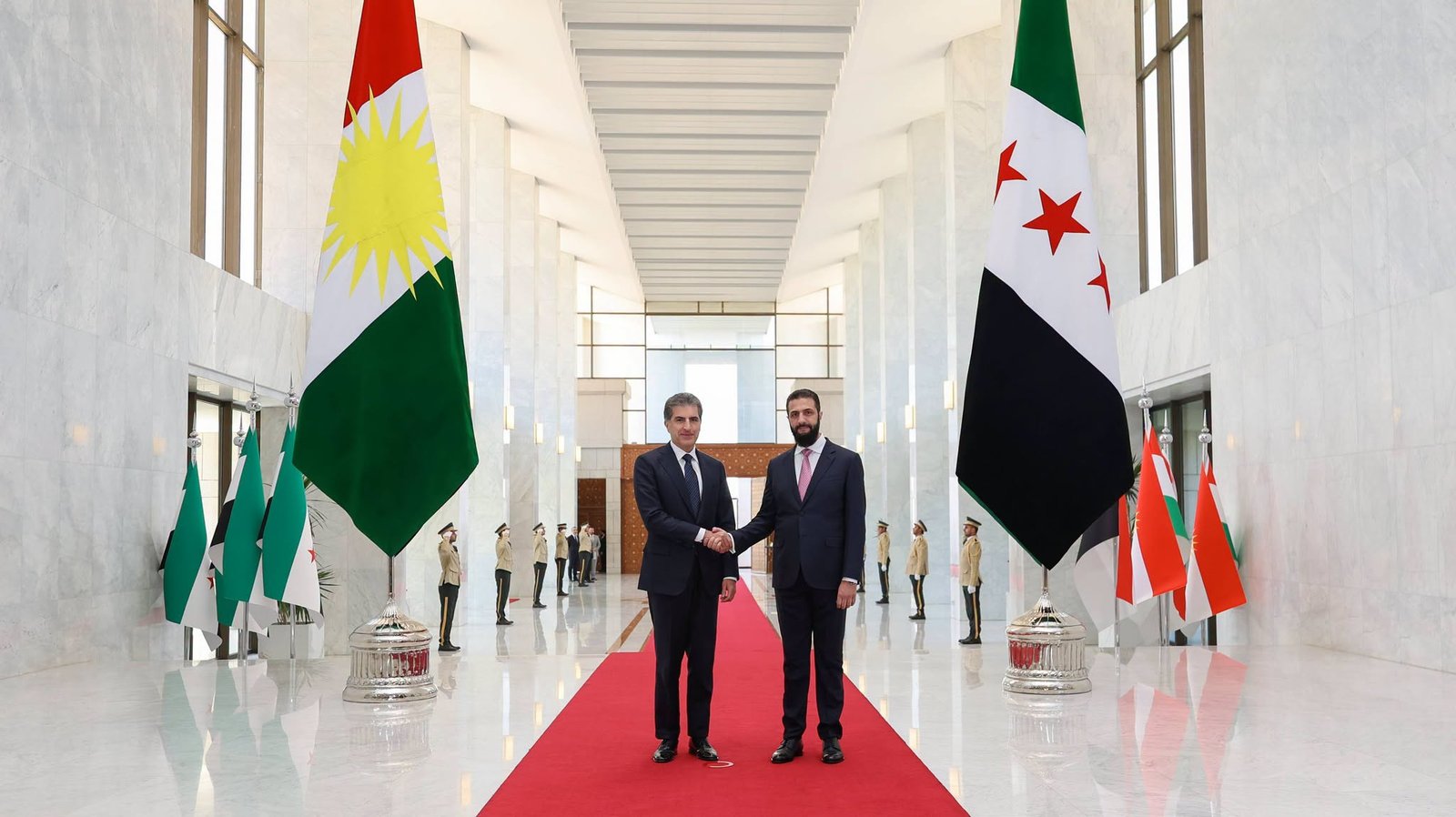
Kurdistan Region President Nechirvan Barzani was received by Syrian President Ahmad al-Sharaa at the People’s Palace in Damascus on Monday, with a giant Kurdistan flag raised beside Syria’s for the occasion. It is the first visit by a Kurdistan Region president since the fall of the Assad government in December 2024. Syrian state media said the talks centred on bilateral relations and economic cooperation, while Syrian officials told AFP the visit was also aimed at advancing the integration of the Syrian Democratic Forces into the state.
Context: The flag carries the visit’s symbolic weight. Its raising in Damascus means the Kurdistan flag has now been raised officially in all four capitals governing sizeable Kurdish populations. Iraq came first, where the 2005 constitution recognised the Kurdistan Region and the flag flies as its official banner. It was then displayed officially in Ankara in 2015 and flown publicly in Turkey two years later. It was raised in Tehran in 2021 when Barzani arrived for President Ebrahim Raisi’s inauguration. Damascus was the remaining capital, and the circle has closed a century after the partition of the Ottoman Empire left sizeable Kurdish populations divided across three new states, with Iran governing the fourth part.
The visit also arrives at a specific point in the Syrian state’s handling of the SDF. Since the January fighting, Damascus has recovered roughly 80% of the territory the SDF held, compressing the question into a far smaller, Kurdish-populated strip along the border. That campaign pushed the SDF into a framework it signed under pressure, and the framework’s central term is structural: no regions and no federal entities, a unitary state secured on paper. What remains is implementation, which Damascus is pursuing through gradual containment and gradual absorption inside the agreement.
Analysis: Al-Sharaa gains more from this moment than first appears. With the territorial balance settled, the SDF file has moved from force to political management, and the reception for Barzani belongs to a set of simultaneous steps Damascus is running on the Kurdish file. The first function is confidence-building. A conflict that has run for over a decade is being wound down through an agreement with regional and international dimensions that require careful handling, and a giant Kurdistan flag at the People’s Palace is a low-cost signal that the state intends coexistence with Kurdish identity.
The second function is division. Syrian Kurdish politics contains three broad constituencies: Kurds assimilated into the Syrian mainstream, the PKK-aligned current organised around the SDF, and the pro-Barzani parties grouped around the Kurdish National Council. The flag raised for Barzani is not the SDF’s banner. PKK-aligned structures have long treated it as the emblem of a parallel political project, banned it in the northeast until the recent change in circumstances, and fly their own colours. Pro-Barzani parties regard it as theirs. The gesture therefore resonates strongly with one half of Kurdish nationalist opinion, and Damascus benefits from a Kurdish scene that cannot easily consolidate into a single bloc.
The distribution of positions runs on the same logic. In the army and the administration, the SDF has taken the larger share, including integration slots in the military and the governorship of Hasakah. In the legislature, pro-Barzani parties dominate the Kurdish seats. The arrangement serves Damascus by keeping the two camps in separate lanes, and it pays each side enough to keep both invested. Parties that had no presence under SDF rule now hold more than they had expected to secure, and for the SDF, official representation inside the state, in the army and in provincial government, is a substantial gain after a decade outside it.
For al-Sharaa, the accounting reduces to two results. He has locked a unitary structure into a signed document, and he has converted the SDF project from a question about the shape of the Syrian state into a bounded file that can be managed over time. The Damascus reception also does external work. Images of the Kurdistan flag over the People’s Palace answer American and European concerns about Kurdish rights and support the presidency’s rebranding as a government with no quarrel with Kurds. They also place Syria inside a regional pattern, since raising the flag for visiting Kurdistan Region leaders has become part of how Ankara and Tehran manage their own Kurdish relationships. The integration model taking shape resembles Turkey’s, with cultural and political rights extended inside a unitary state and no territorial autonomy attached.
For Barzani, the visit has its own logic. Economic and business files are on the table, and Syrian state media placed economic cooperation at the centre of the talks. The larger driver is realism. The new order in Damascus was imposed on the ground and is now recognised by Europe and the United States, and deepening ties with al-Sharaa in exchange for cultural and broader rights for Syria’s Kurds is the outcome available to deliver at present.


