


The Fulcrum Doctrine: Washington’s Economic Architecture Across Iraq and Syria
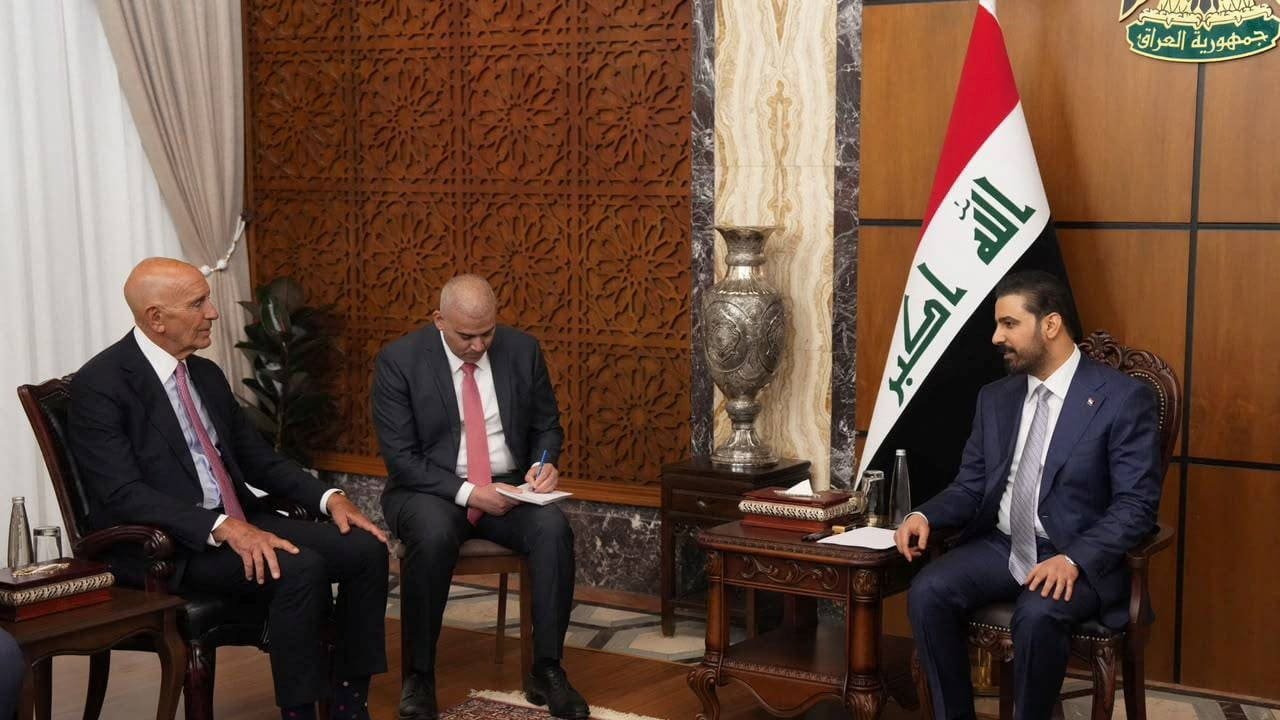
On 16 June the US Embassy in Baghdad released a joint statement from Prime Minister Ali al-Zaidi and Special Presidential Envoy Tom Barrack, following their meeting in the capital the previous day. Two features stand out. First, the document fuses security and commerce in a single breath. It pairs Iraq’s commitment to the “complete disarmament and disbandment” of armed groups outside state control with a package of American projects: the Starlink operating licence, Chevron’s entry into West Qurna-2 and Nasiriyah, security guarantees for HKN, Western Zagros and Hunt to resume operations, an Excelerate Energy LNG terminal at Khor Zubair, and a memorandum of understanding with TI Capital to rehabilitate the Kirkuk-Baniyas pipeline. Second, Trump will host al-Zaidi at the White House in mid-July.
The Syrian side unfolded over the same days. From 9 to 13 June, Syria’s energy minister, Mohammad al-Bashir, was in Washington meeting US energy companies. On 16 June, the Syrian Petroleum Company signed a development agreement with ConocoPhillips and Novaterra, the first of its kind between a major US oil company and the new Syrian government. President Ahmed al-Sharaa later received the companies’ executives at the presidential palace in Damascus. A day earlier, the deputy governor of Hasakah confirmed that HKN Energy had begun operating oilfields that the Syrian Kurdish forces had recently transferred, at least formally, to Damascus.
Taken together, the Iraqi and Syrian deals suggest that Washington is treating the two countries as parts of an increasingly connected commercial and energy space.
Context: Barrack now holds three positions at once: US ambassador to Turkey, special presidential envoy for Syria, and, as of this visit, special presidential envoy for Iraq. That places Ankara, Baghdad and Damascus under a single senior channel rather than three separate desks. He opened his first tour covering both Syria and Iraq in Baghdad, then travelled to Erbil for talks with Kurdish leaders.
The corporate map tells the same story. Several of the firms named in the Iraqi statement are moving into Syria in parallel. HKN Energy is the clearest bridge of all: already an operator in the Kurdistan Region and federal Iraq, it now runs those former SDF fields inside Syria, a single firm straddling the frontier. Chevron, while negotiating West Qurna-2 in Iraq, holds an offshore exploration arrangement in Syria with a Qatari partner. ConocoPhillips is signing in Damascus and is also part of a TotalEnergies and QatarEnergy consortium examining Syria’s offshore Block 3. Baker Hughes, Hunt and Argent LNG have drawn up a Syrian energy masterplan and weighed a wider US-Saudi consortium across the northeast. Hunt is, in turn, one of the operators whose security the Iraqi statement explicitly underwrites.
The physical spine is the Kirkuk-Baniyas pipeline. Built in 1952 and idle since 2003, it once carried northern Iraqi crude to the Syrian Mediterranean coast. Reviving it, with capacity discussed at up to one million barrels per day, would give Iraq a European outlet that bypasses the Strait of Hormuz, and give Syria transit revenue and the standing of an energy corridor rather than a mere producer. Iraqi and Syrian officials frame the broader ambition through the Four Seas Initiative, linking the Gulf, the Caspian, the Mediterranean and the Black Sea, with Syria and Turkey as the hubs. The TI Capital memorandum places an American financial actor inside that artery.
Analysis: What to call it is now easier, because Washington has written much of it down. The corridor is best understood as a US-led Iraq-Syria, or Mesopotamian-Levantine, economic-security architecture, and it reads as the regional execution of the National Security Strategy the administration released in December. That document makes energy dominance and economic statecraft the instruments of national power, treats technological competition as a question of power rather than commerce, and recasts the Middle East as a theatre that should recede as a military burden and expand as a destination for investment, in oil and gas but also nuclear energy, AI and defence technology. The Baghdad statement and the Damascus signings are that doctrine arriving on a map.
Energy, telecommunications and pipelines carry the weight here, rather than ordinary trade, because they are foundational systems rather than products. A shipment of oil ends; a pipeline, an LNG terminal, a power station or a satellite network creates a relationship that runs for decades, sustained by spare parts, software, finance, trained staff, compatible standards and the continued presence of the supplier. Set one on top of another and the projects named this year begin to resemble the operating system of a connected economy rather than a list of deals: production through Chevron, HKN, Hunt and ConocoPhillips; oilfield services through Baker Hughes; power through GE Vernova and Gulf-backed generation; imports through Excelerate’s proposed Khor Zubair terminal; transit through Ceyhan and the Kirkuk-Baniyas line; the digital layer through Starlink; capital through American and Gulf investors; and coordination through Barrack across all three states. The Starlink licence, to be precise, embeds an American company and American standards in Iraq’s communications future. On the available evidence it does not hand Washington the network or its users’ data, and that distinction is worth keeping.
The most direct link to the strategy is cost. Infrastructure-led policy lets Washington supply the cheaper inputs, coordination, political guarantees, sanctions relief and access to American technology, while US firms supply capital, operations and standards, Turkey supplies transit, construction and regional hard power, the Gulf supplies money, and Baghdad and Damascus supply resources, territory, contracts and the duty to keep the corridor secure. The clearest name for this is infrastructure-based burden-shifting: the influence a garrison once bought, reached through other balance sheets. Washington need not post troops at Rmeilan to keep a stake there if an American company holds the long-term contract, the field feeds the regional pipelines, and Gulf or Western finance underwrites it. Leverage moves from holding territory to owning the systems that make territory economically functional, which is the burden-sharing the strategy explicitly prefers, rendered in steel and fibre rather than troop numbers.
The architecture is built to resist reversal. Once billions are committed to a pipeline, a processing plant or a national network, a coalition forms around keeping it running: governments want the revenue, firms want returns, banks want repayment, workers want the jobs, neighbours want the flow. Infrastructure manufactures its own constituency, and that can outlast a treaty. Iraq and Syria need not become formal allies of the United States; they need only be wired deeply enough into a system of American and Gulf investment that its continued operation requires their cooperation. Each such choice also quietly narrows the room for rival networks, Iranian, Russian, Chinese, or those of autonomous armed and political actors, without a single formal expulsion, because the next layer is simply being built through other hands.
For Kurdish actors the implications are sharp, and they sit at the seam of the whole design. The model rewards centralisation, and the assets moving first are Kurdish-adjacent: the Hasakah fields lifted from SDF control and handed to an American operator, the Kirkuk crude that would feed Baniyas, the Erbil leadership Barrack courts on the same trip in which he presses Baghdad to disarm. Barrack’s own language, of weaving the region’s tribal, religious and sectarian differences into one coherent order, describes the same instinct, and from Erbil or Suwayda the loom can look less like unity than subordination.
None of this has been proclaimed as a regional doctrine, and much remains contingent. The militia file is unresolved, the pipeline would require years and billions of dollars, and several Syrian agreements remain memoranda rather than producing assets. What the strategy sets out explicitly is the method: energy, technology and capital as the principal levers of a lighter American footprint.
Yet the pattern is too coherent to dismiss as a series of unrelated contracts. Washington is attempting to assemble a regional order less dependent on Iran across Iraq and Syria, largely in American ink and on other people’s budgets.
Calling it a post-Iranian order, however, would be premature. Iran survived the war, and the agreement that ended it may ultimately leave Tehran more confident rather than diminished. The architecture now taking shape is therefore better understood as an attempt to contain and bypass Iranian leverage, not evidence that Iran has already been displaced.


