


Baghdad Turns to the Printing Press as Oil Revenue Holds Near $1 Billion
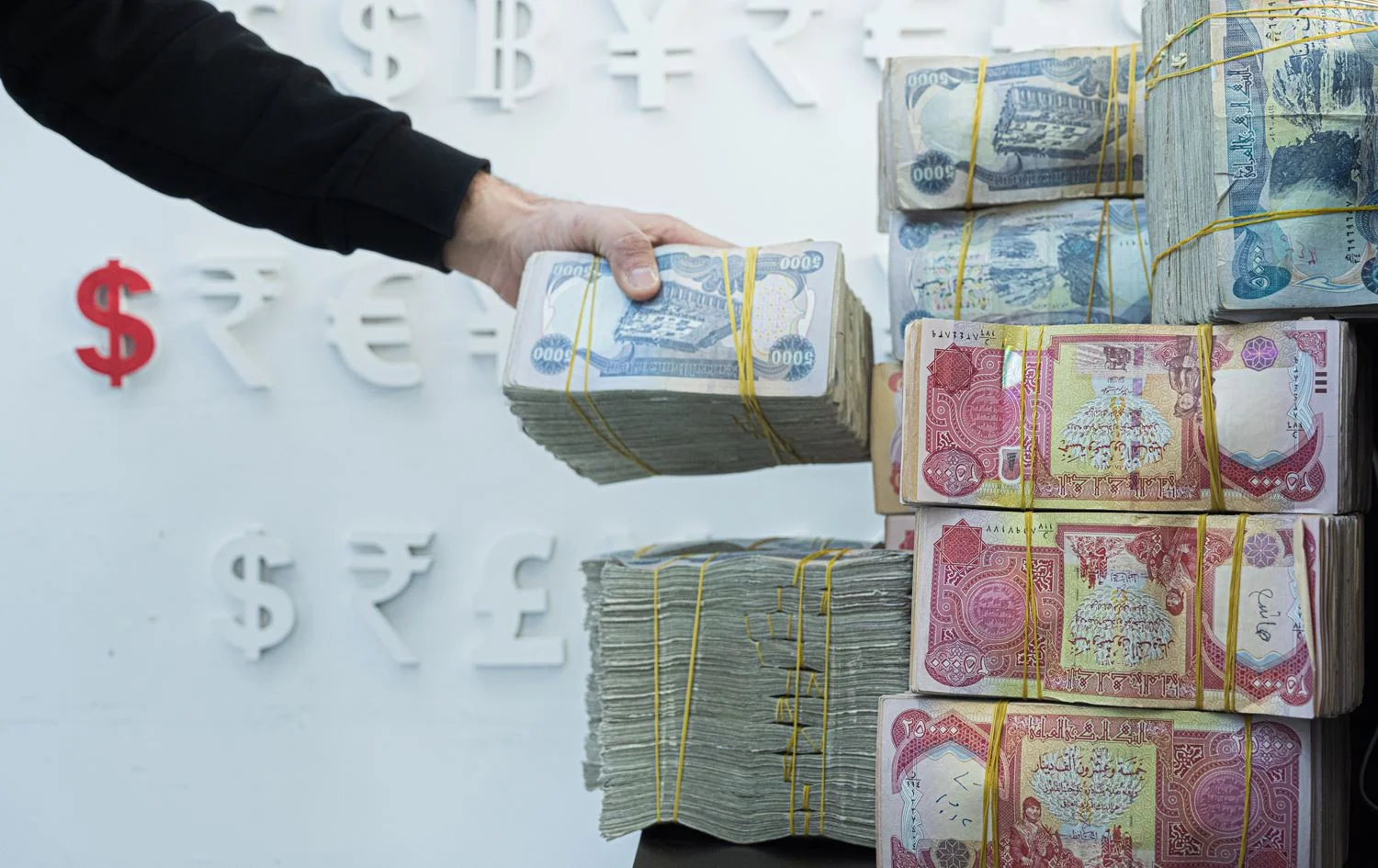
Iraq has begun printing money to manage the fiscal crisis triggered by the closure of the Strait of Hormuz, Foreign Minister Fuad Hussein confirmed in an interview with Al-Sharqiya television on Saturday. The Central Bank has issued around 25 trillion dinars, roughly $19 billion, raising the total currency in circulation to about 125 trillion dinars from a previous level of between 100 and 104 trillion.
Hussein went further than any senior official to date in describing the danger. He warned that Iraq will be unable to pay public-sector salaries next month if Hormuz remains closed, and that a continuation of the war to the end of 2026 would be, in his words, a disaster, because there is no revenue. That is a clear break from the government’s earlier insistence, maintained through visible strain, that payroll would be protected.
The Central Bank pushed back on the framing. It rejected the description of its actions as printing money to fund salaries, arguing that what took place was the discounting of treasury bills, a standard liquidity mechanism repaid at maturity, rather than the issuance of currency against no assets, which is prohibited under Central Bank Law No. 56 of 2004. The institutional dispute over terminology matters less than the shared underlying fact: liquidity is being manufactured to bridge a gap that oil revenue is no longer filling.
That gap is now entering its third month. A final SOMO or Oil Ministry figure for May has not been published, but available export tracking and official estimates place May oil revenue at around $1 billion, broadly in line with April and far below the pre-crisis norm.
Context: The scale of the reversal is clearest across four months. In February, the last normal month, Iraq exported 99.87 million barrels and earned $6.81 billion, at a daily average of 3.567 million barrels. March, the first war month, saw exports fall to around 18 million barrels and revenue to roughly $2 billion. April brought the floor lower still: 9.84 million barrels, $1.087 billion, a daily average of 328,000 barrels. May’s estimated $1 billion, on a similar implied volume of around 10.2 million barrels, confirms the new level rather than breaking from it.
The headline export figures understate the wider disruption. Iraq’s crude production has fallen from around 4.3 million barrels per day before the crisis to roughly 1.4 million, yet exports are running far below even that reduced output, at around 329,000 bpd in May. The difference reflects the loss of the routes that carry crude to market rather than a halt in pumping.
What remains of Iraq’s export flow has been redrawn around whichever routes stayed physically open. Of the roughly 329,000 bpd exported in May, around 233,000 bpd moved north through the Kurdistan-Ceyhan pipeline, while only 96,000 bpd transited Hormuz. Close to 70 percent of the country’s entire export flow now runs north to the Turkish coast rather than south through the Gulf, an inversion of the normal pattern in which Basra’s southern terminals dominate the ledger. Seaborne exports, which exceeded 3.3 million bpd before the war, have effectively ceased to function as the country’s main revenue artery.
A further qualification applies to the revenue figure itself. SOMO and Oil Ministry numbers report the gross value of exported crude, not the cash that reaches the Central Bank for the government to spend. Company entitlements, the shares owed to international operators under service contracts, typically absorb 17 to 25 percent of gross oil value, and the remainder arrives with a timing lag. A gross figure of around $1 billion therefore implies net receipts to the state closer to $750 to $830 million, and later than the month in which the oil was sold.
Against that income stands a fixed wall of obligations. As of January 2026 Ministry of Finance data, salaries, pensions and social welfare transfers, the mandatory monthly cash payments to individuals, come to roughly $5.45 billion: 5.09 trillion dinars in salaries, 1.6 trillion in pensions, and 458 billion in welfare. Total operational expenditure runs higher, at around $7.2 billion, and total spending including investment reaches around $8.4 billion. The salary line is the floor the government will defend before all else.
Analysis: The most revealing way to read the crisis is not month by month but cumulatively. Measured against the salary, pension and welfare line alone, the narrowest definition of what the state owes its own people, oil revenue has fallen short by a widening margin since March, and the shortfalls have compounded into a substantial three-month hole.
Across March, April and May, oil has covered barely a quarter of the cheapest possible version of the state’s monthly commitments. Non-oil revenue, perhaps $300 to $400 million a month from customs and taxes, narrows each month’s gap by a few hundred million but does not change its shape. Measured against total operational expenditure rather than the salary line, the cumulative three-month gap approaches $17.5 billion; against total spending including investment, it nears $21 billion. These are the holes the government has had to fill since the war began, on top of an economy the IMF expects to contract by 6.8 percent this year.
The crisis did not create Iraq’s deficit; it detonated the part of it that was previously safe. In February, oil revenue of $6.81 billion covered the salary line with well over a billion dollars to spare. Even then the budget ran a structural gap against total spending, a continuation of a long pattern in which a swelling public payroll, used by the ruling parties as an instrument of patronage and a sponge for unemployment, outpaced revenue. Iraq ran a deficit approaching $10 billion across 2025 with oil still near $7 billion a month. What the war did was collapse the revenue side so completely that oil no longer covers even the wages and pensions that had always been the one obligation comfortably met.
Three buffers are absorbing the shortfall, and Hussein named all of them. The first is foreign-exchange reserves, which stood at around $97 billion and notionally cover about a year of imports, but which carry currency and confidence risks if drawn down aggressively. The second is borrowing: reported figures put domestic borrowing at around $8 billion in the first four months of 2026 alone, a pace set against a finite domestic appetite for government debt. The third, now confirmed, is monetary financing, the roughly $19 billion in newly issued dinars Hussein disclosed. Each lever carries a cost. Reserves protect the dinar; borrowing accumulates and crowds out; printing, as Hussein himself acknowledged, risks inflation, higher prices and weaker purchasing power. S&P has already placed the sovereign rating on CreditWatch negative, citing fiscal and external pressure through the rest of 2026.
The official timeline has compressed sharply. A prime ministerial adviser warned in late April that the cash-flow impact would become acute across May and June, with analysts pointing to July as the month beyond which internal cash management alone could no longer close the gap. Hussein’s intervention pulls that horizon forward: a sitting minister is now naming next month as the point at which salaries themselves are at risk. His proposed remedies underline how little room remains. Raising alternative exports to between 500,000 and 700,000 bpd, including a restart of KRG production through the Iraq-Turkey pipeline, would help at the margin but, by his own description, would not resolve the underlying problem. His call to open up to the Gulf states and Western countries for assistance is the clearest signal yet that Baghdad regards its domestic options as approaching exhaustion.
Iraq is earning, from all hydrocarbon sources combined, somewhere between a sixth and a fifth of what it needs to pay its employees and pensioners, and it is closing the difference by drawing down reserves, borrowing at a pace it cannot sustain, and printing money its own foreign minister warns may not be enough. A partial reopening of the southern export routes would change the calculation quickly. There is still no sign of when that might come.


