


Turkey’s CHP Crisis Is About The State Erdogan Wants To Leave Behind
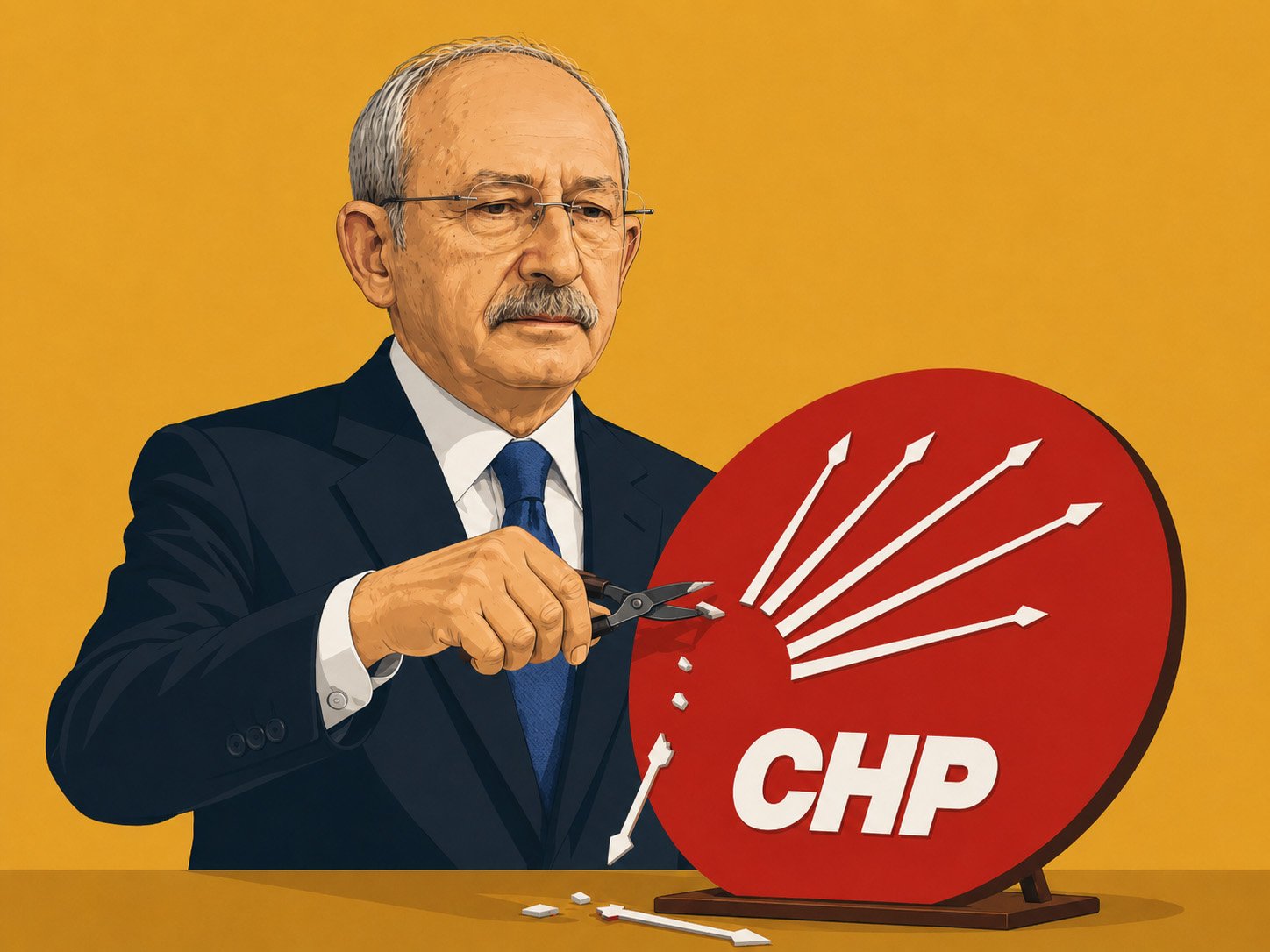
The court intervention against Turkey’s main opposition party, the CHP, should not be read only as a legal dispute over a party congress. Nor is it simply another tactical move by Erdogan to weaken the opposition before the next election. It is better understood as part of a wider regime-building process: an attempt to reorder Turkey’s internal political field, contain the CHP’s revival, and create a broader system of managed representation that can outlast Erdogan himself.
The annulment of the CHP’s 2023 congress, which removed Ozgur Ozel and restored Kemal Kilicdaroglu, came after Ozel had revived the party and helped turn it into Turkey’s leading electoral force in the 2024 local elections. It also followed a wider wave of pressure on CHP figures, including the imprisonment of Ekrem Imamoglu and legal pressure on opposition municipalities. The ruling therefore does not merely reverse an internal leadership contest; it intervenes directly in the future of Turkey’s main opposition.
1. The restoration was prepared politically before it was delivered legally
The court ruling did not arrive in a vacuum. One day before the decision, Kilicdaroglu released a controversial video accusing the current CHP leadership of moral decay and presenting his faction’s role as one of cleansing, reckoning and correction. Turkish journalist Murat Yetkin noted that the timing of the video, published on May 20, raised the question of whether Kilicdaroglu and those around him had anticipated, or had been informed, that the absolute nullity ruling was about to be issued before the extended holiday period. The ruling came the next day.
That timing matters because Kilicdaroglu’s message closely tracked the language pro-government media had used for months to frame the CHP crisis: corruption, moral decay, a tainted congress and the need to cleanse the party. In other words, the Kilicdaroglu faction was not merely benefiting from the court ruling after the fact. It had already adopted the moral and legal vocabulary through which the ruling bloc had justified intervention in the CHP.
The media choreography after the ruling reinforced the same impression. Kilicdaroglu’s first public message after the decision was given to TGRT Haber, a pro-government outlet, where he reportedly said the ruling was auspicious for Turkey and the CHP. Days earlier, TGRT and Turkiye had already carried claims attributed to Kilicdaroglu accusing the current CHP leadership of irregularities over the disputed congress, although those claims were later denied by his lawyer and removed.
The pattern became clearer when Kilicdaroglu appointed journalist Atakan Sonmez as his new press adviser. Both Sozcu and 10Haber reported that Sonmez had recently appeared regularly on TGRT broadcasts that supported the absolute nullity line in the CHP dispute.
This does not prove a formal written agreement between Kilicdaroglu’s faction and the state. What it does show is convergence at three levels: timing, narrative and media infrastructure. Kilicdaroglu’s faction appeared ready for the ruling before it came, spoke in the same moral language as the pro-government campaign against the CHP leadership, and then used pro-government media channels to manage its first messaging after the court intervention.
2. The MHP Precedent: Preserve The Shell, Expel The Insurgency
The closest precedent is the MHP crisis of 2015 to 2017. After the MHP’s poor performance in the June 2015 elections, Meral Aksener and a group of dissidents sought an extraordinary congress that could have displaced Bahceli. The confrontation moved through the courts, with competing procedural claims and rival efforts to control the congress process. Bahceli prevailed. The dissident faction was blocked, Aksener eventually founded the Iyi Party in 2017, and Bahceli retained the institutional apparatus intact.
When Erdogan needed a coalition partner to pass the 2017 constitutional referendum, Bahceli was there with the MHP’s parliamentary machinery fully under his control. The party he had preserved became an indispensable pillar of the presidential order.
The technique is the same here: preserve the institutional shell, protect the system-compatible leadership, and push the dynamic faction outside under conditions that make rebuilding difficult. Kilicdaroglu inherits the CHP name, the parliamentary group, the historical connection to the republic, and the branch infrastructure. Ozel and the Imamoglu current face fragmentation, a prolonged internal legitimacy war, or the prospect of building a new party under considerably harsher conditions than the Iyi Party encountered.
The CHP is a larger and more consequential institution than the MHP was in 2016, and the organizational resistance from Ozel’s camp has real depth. However, the MHP experience showed that this technique can work even against genuine popular resistance, provided the institutional apparatus ends up in the right hands.
3. Kilicdaroglu As The System-Compatible Figure
Kilicdaroglu’s usefulness to this project lies in his political personality, factional instincts, and institutional biography. He is considerably more compatible with the regime’s needs than the leadership he is replacing.
He spent formative years as a senior bureaucrat under President Suleyman Demirel, and that background left a lasting imprint on his approach to the state. His politics have often been shaped by caution, state deference, and institutional accommodation, which distinguish him from the more confrontational Ozel-Imamoglu current. He does not generate the cross-sectarian and cross-class mobilizing energy Imamoglu demonstrated through two Istanbul mayoral campaigns. His presidential strategy, from the 2014 Ekmeleddin Ihsanoglu nomination to his own 2023 candidacy, produced defeats that narrowed rather than expanded the CHP’s path to power.
All of this makes him, from the regime’s perspective, an opposition figure without the capacity for alternation: sufficiently oppositional to preserve the form of pluralism, but not threatening enough to disturb the architecture of power.
The analyst Levent Gultekin has argued that Kilicdaroglu’s choices at key moments, including his handling of the unstamped ballot controversy in the 2017 referendum and his approach to the 2023 presidential campaign, reflected a deep state-mindedness. Whether one accepts that reading in full or not, the pattern is real. Kilicdaroglu repeatedly acted as if state preservation mattered more than opposition rupture, even when that logic weakened his own side. That is precisely the profile the ruling bloc needs for the CHP’s new role.
4. Bahceli As Architect Of Incorporation
Bahceli’s role deserves analysis beyond his function as Erdogan’s coalition partner, because his interventions across multiple political files have a coherence that points to something more than alliance management.
Bahceli helped make the 2017 presidential system possible by providing nationalist cover for Erdogan’s constitutional transformation. More recently, he has been central to the renewed Kurdish opening. On 5 May 2026, two weeks before the CHP ruling, he proposed that Ocalan be given a formal institutional role under a body he named the “Peace Process and Politicization Coordinatorship,” stating that “our goal is for the founding leadership of the PKK to serve under this definition.” The proposal converts the Kurdish file from an armed conflict into a state-managed political channel, with Ocalan as its recognized anchor.
His language on the CHP runs on the same logic. Bahceli described the party as one of the most important political institutions since the founding of the republic and warned against it being mixed up or fragmented. He is not defending the CHP as a democratic opposition force. He is defending it as a founding institution of the state order that should be preserved and incorporated, not destroyed.
Just as Ocalan is being recast as a recognized stakeholder on the Kurdish file under the title of “founding leadership,” the CHP is being recast as the recognized stakeholder for secular-republican and Alevi constituencies under a restored founding-era leadership.
The word “founding” is doing the same work in both cases. It confers the authority to be incorporated into the new order as a legitimate representative of origin, rather than treated as a disruptive external force. After the ruling, Bahceli called on Kilicdaroglu not simply to consolidate his restoration, but to negotiate a common formula with Ozel and declare feragat, or renunciation. That made clear that the court ruling was an instrument for forcing a settlement, not necessarily the endpoint of the operation. This is managed incorporation, and Bahceli is its principal architect.
5. The Alevi Dimension: Implied Representation Without Formal Recognition
Kilicdaroglu was the first person from an Alevi background to lead a mainstream Turkish party at this scale. In the context of a regime moving toward managed communal representation, that fact acquires structural significance beyond identity symbolism.
This is not a random identity argument. Bahceli himself has already placed Kurdish and Alevi representation into the language of institutional redesign. In July 2025, he confirmed that he had floated the idea of a system in which one presidential vice president would be Kurdish and another Alevi. The MHP later published a written statement under the heading of Bahceli’s “Alevi and Kurdish Vice President” idea, rejecting the claim that this amounted to Lebanese-style sectarianism, but not denying that he had raised the proposal.
The visible pro-Kilicdaroglu faction inside the CHP is small, but it is not sociologically random. A striking number of the figures associated with, or sympathetic to, that current are Alevi, Alevi-linked, or rooted in regions where Alevi political networks are central to CHP politics. This includes names such as Gursel Erol, Ali Oztunc, Mahir Polat, Semra Dincer, Sevda Erdan Kilic, Ali Fazil Kasap, Kadim Durmaz, Inan Akgun Alp, Erdogan Toprak and Orhan Saribal, alongside softer or more likely cases such as Gamze Akkus Ilgezdi, Huseyin Yildiz, Gulizar Bicer Karaca and Rifat Nalbantoglu.
The point is not to reduce each figure to identity. It is that the faction’s sociology overlaps with the social blocs the CHP has long represented. The CHP has historically functioned as the natural institutional address for secular, social-democratic, and predominantly Alevi-identifying communities in Turkey. A Kilicdaroglu-led CHP, bounded in its electoral reach and presided over by a figure whose state-mindedness has been demonstrated repeatedly, can serve as a recognized vehicle for Alevi and secular-republican political participation without threatening the ruling formula.
Over time, this can consolidate into implied community representation: Kilicdaroglu as the recognized address for Alevi constituencies within a broader brokered arrangement, in much the same way that Ocalan’s acknowledged role on the Kurdish file implies community representation without being formally designated as such. The parallel between the two files, applied to two historically marginalized communities whose political integration the state now appears to be managing simultaneously, is structurally deliberate rather than coincidental.
Alevis are not a homogeneous bloc, and many have responded to Kilicdaroglu’s restoration with sharp hostility. However, in this kind of political architecture, formal consent from the represented community is not the operative mechanism. What matters is that the broker has sufficient institutional standing and community legibility to function as the address through which the state manages that relationship. Kilicdaroglu has that standing, and the court has restored the platform.
6. From Electoral Domination To Post-Erdogan Regime-Building
The framework described above is oriented to a horizon longer than the next election. It is about the construction of a post-Erdogan order while Erdogan is still in place to build it.
A regime built entirely around one figure’s electoral success is structurally fragile. It remains vulnerable to that figure’s defeat, decline, exit, or loss of coalition control. A more institutionalized system needs something else: recognized stakeholders, managed channels of representation, and a political field in which opposition is incorporated rather than allowed to become a vehicle for alternation.
The parliamentary commission framework around the PKK peace process made the strategic logic explicit. Domestic settlement was framed not as an end in itself, but as the prerequisite for fortifying Turkey’s internal front ahead of intensifying regional instability. “Terror-Free Turkey,” in this reading, is also a vision of a terror-free region. It connects the internal Kurdish settlement directly to Turkey’s ambitions for greater power projection across a neighborhood shaped by the Iran conflict, an unstable Syria, and a Kurdish question spanning multiple state borders.
A state seeking to act more assertively abroad in an era of multipolarity and declining Western liberal authority needs internal cohesion as a strategic asset. The Kurdish file, the CHP intervention, the Alevi-channel implication, and the preservation of the MHP as nationalist anchor are all components of the same consolidation.
What emerges is not a monolithic one-party system. It is a regime of factional diversity within an expanded perimeter: nationalists, Islamists, Kurdish political channels, secular-republican institutions, and implicitly Alevi representation all given space, on the condition that they operate within the system’s architecture rather than against it.
Some Turkish analysts describe this trajectory as Lebanonization. The term should be used carefully. Turkey is not literally adopting the Lebanese confessional system. The more precise point is that Turkey appears to be moving toward brokered representation under a strong executive, where major political questions are settled among recognized stakeholders rather than through open electoral competition.
Conclusion
The CHP crisis is a test of whether Turkey’s main opposition can still belong to society, or whether it will be returned to the state.
The MHP crisis established the method. The Kurdish opening established the broader logic. The CHP ruling applies both at the scale of the country’s largest opposition institution. Bahceli connects all three processes as the principal architect of a system designed to outlast Erdogan, manage a multipolar regional environment, and convert opposition itself from a competitive threat into a recognized stakeholder within the order.
A Kilicdaroglu-led CHP would not need to threaten the regime. It would need only to make the party available to the new order as its republican, secular, and implicitly Alevi component. Ozel and Imamoglu represented the opposite: a CHP capable of breaking out of managed opposition and becoming the center of a real political transition.
That is why the ruling matters well beyond the immediate leadership question, and why the resistance from the CHP’s organizational base matters more than its formal legal status. Whether that resistance can disrupt a mechanism that has, until now, operated with considerable precision will determine whether Turkey’s main opposition remains an institution that competes for the state, or becomes one that belongs to it.


