


Why Iran’s Kurds Are the Most Divided Kurdish Population
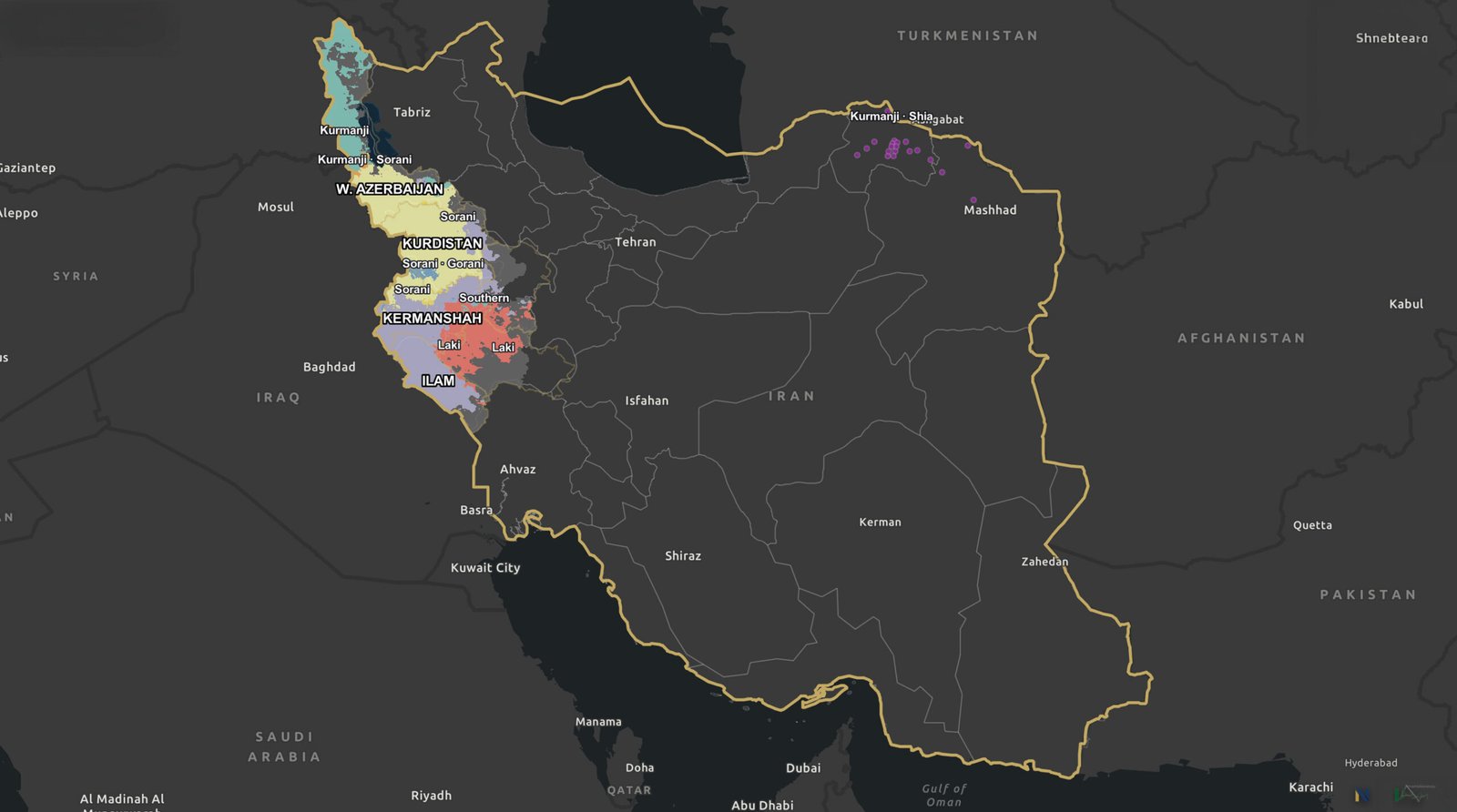
The Kurds of Iran are the most internally divided Kurdish population across all four parts of Kurdistan. Dialect, sect, geography, and five centuries inside an Iranian state have produced a fragmentation that has no parallel in Iraq, Syria, or Turkey.
To understand Kurds in Iran, three different maps have to be separated at the outset: ethnic self-identification, mother tongue, and political behaviour. In the other three main Kurdish arenas, those three tend to overlap more closely. In Iran, they do not. A person may identify as Kurdish, speak a dialect only partly intelligible to other Kurds, live in a sectarian environment very different from the Sunni Kurdish core farther north, and behave politically in ways shaped less by Kurdish nationalism than by sect, tribe, state incorporation, and proximity to neighbouring Iranian-speaking populations. That layering is what makes the Iranian Kurdish field uniquely fragmented from within.
A linguistic mosaic, not a bloc
Iranian Kurds are not a compact Sorani-Kurmanji population. They are a mosaic of at least four major speech groups whose boundaries blur into one another and, critically, into neighbouring non-Kurdish Iranian languages.
The roughest defensible estimate is that Central Kurdish, usually called Sorani, accounts for around 35 to 40 per cent of Iran’s Kurds. Southern Kurdish together with Laki, if Laki is folded into it as most recent scholarship allows, likely makes up another 35 to 40 per cent. Kurmanji accounts for roughly 22 to 27 per cent. Gorani and Hawrami together make up a small but historically significant remainder of perhaps 2 to 4 per cent.
On a midpoint model of about 9.5 million Kurds in Iran, that translates to roughly 3.4 million Sorani speakers, 3.6 million Southern Kurdish speakers, 2.2 million Kurmanji speakers, and around 300,000 Gorani or Hawrami speakers. These are reconstructions from dialect geography and settlement patterns, not census figures; Iran does not publish a fine-grained linguistic census, and even the Atlas of the Languages of Iran stresses that its dialect distribution data are estimates, not headcounts.
That mosaic alone already makes Iranian Kurdistan more internally fractured than the Kurdish belts in Iraq and Syria or even Turkey, where Sorani and Kurmanji dominate in more compact and politically legible blocs. But the fracturing goes deeper. Kurmanji itself is split across radically different settings. The Kurmanji-speaking Kurds of Khorasan in the northeast are mostly Shia, long settled, and far more integrated into the Iranian state than any part of the northwest. The Kurmanji-speaking Kurds of the Urmia and far northwestern belt are overwhelmingly Sunni and tied into a borderland environment shaped by proximity to Turkey and to the wider Sunni Kurdish world farther west. Central Kurdish dominates the classic nationalist belt of Kordestan Province and the Mukriyan towns of West Azerbaijan. Southern Kurdish and Laki stretch through Kermanshah and Ilam, a much more mixed zone where Kurdish shades into neighbouring Iranian speech forms, Luri in particular.
A sectarian split with no parallel
Religion reinforces the linguistic fragmentation. In Iraq, Syria, and Turkey, the large majority of Kurds are Sunni. In Iran, the sectarian picture is far more divided.
The best rough estimate is that roughly half of Iranian Kurds are Sunni, around two-fifths are Twelver Shia, and about a tenth are Yarsani, with the last category the most uncertain. On a 9.5 million midpoint, that suggests about 4.7 to 4.9 million Sunnis, around 3.7 to 3.9 million Shia, and close to one million Yarsanis. That alone sets Iran apart from the other three parts of Kurdistan.
The sectarian map overlaps heavily with the dialect map. Khorasan Kurmanjis pull Kurmanji partly into the Shia orbit. Southern Kurdish and Laki sit largely in the Shia and Yarsani belt of Kermanshah and Ilam. The Sunni core is concentrated in Kurdistan Province and across the Kurdish-majority districts of West Azerbaijan, meaning the northwest carries a disproportionate share of the religious and political identity that outsiders most readily associate with Kurdish Iran. But that northwest is not the whole of Kurdish Iran, and the assumption that it is has distorted much of the analysis.
Kurdish inside an Iranian world
The deepest structural difference between Iran and the other three settings is linguistic. In Iraq and Syria, Kurdish confronts Arabic across a sharp civilisational and typological line: Kurdish is Indo-European, Arabic is Semitic. In Turkey, the divide is similarly deep: Kurdish is Indo-European, Turkish is Turkic. But in Iran, Kurdish and Persian are both Western Iranian languages with a common origin. The boundary between them is not a wall. It is a slope.
That slope runs through the Kurdish population itself. Lori forms a continuum between Kurdish and Persian. Laki sits near that transitional zone. As one moves south through the Zagros from the Sorani and Kurmanji heartlands, speech forms become progressively less like northern Kurdish and more entangled with neighbouring Iranian varieties. The transition is not only between Kurdish and Persian directly; it runs through a chain of intermediate forms, each of which shares more with its geographic neighbours than with the Kurdish speech of the far northwest. Iran does not present a clean Kurdish versus non-Kurdish language frontier. It presents a graded continuum, and continuums are harder to politicise than walls.
That matters immensely. A Shia Southern Kurdish speaker in Kermanshah lives in a religious environment that overlaps more with the Persian and Luri Shia world around them than with the Sunni Kurmanji speakers of the Urmia belt. A Khorasan Kurmanji, despite speaking one of the purest forms of Northern Kurdish, has been socialised for centuries inside a Shia, Persian-dominant provincial setting far removed from the political energies of the northwest. Ethnic identification persists, but it competes much more directly with sect, locality, and an older Iranian civilisational frame.
Five centuries inside the same state
History compounds this. Iranian Kurds have lived within an Iranian state framework for roughly five centuries, if one takes the Safavid consolidation of the early sixteenth century as the starting point for the modern Iranian political order. The dynasties changed, the borders shifted, and the state was repeatedly remade, but the Kurdish regions inside Iran were not suddenly absorbed by a brand new entity a century ago in the way that Kurdish regions were incorporated into Iraq and Syria after the First World War. Iran entered modern nationalism with a much older historical consciousness and a deeper institutional memory of managing its peripheries.
Iran is also closer to what some scholars call a civilisational state than to a standard European-style nation state. It carries a political identity built on layered Persian, Shia, and imperial traditions that predate modern nationalism by centuries. The Kurdish presence inside that civilisational frame is not new. It is old, and in some parts of the country, deeply woven into the wider Iranian fabric. That does not make Kurdish identity disappear. But it does make the terrain around it more absorptive, more ambiguous, and far less polarised than in the Arab and Turkish settings.
The result
Iran’s Kurds are unique among the four Kurdish fields not simply because they are divided, but because the divisions are layered and mutually reinforcing. The dialect map is fragmented into at least four major groups. The sectarian map is split close to evenly. The linguistic boundary with the state-bearing language is shallow and gradual. The southern belt transitions toward other Iranian speech forms rather than ending abruptly. The northeastern Kurmanji belt is Shia and historically incorporated into the state. The western and northwestern Sunni belt remains the main centre of Kurdish nationalist mobilisation, but it does not speak for the whole of Kurdish Iran.
Ethnic identification, mother tongue, and political behaviour do not line up neatly. In Iraq, Syria, and Turkey, Kurdish identity confronts the state-bearing identity across a sharper frontier, and that sharpness has historically made cohesion easier to build. In Iran, Kurdish identity sits inside a broader Iranian civilisational and linguistic space while being internally split by dialect, sect, and geography. That has not erased Kurdish politics, but it has made Kurdish cohesion structurally harder to build, and far easier for the state to segment, absorb, and contain.


