


Shaikan Oil Production Tops 9.6m Barrels in First Eight Months of 2025, Revenue Hits $269m
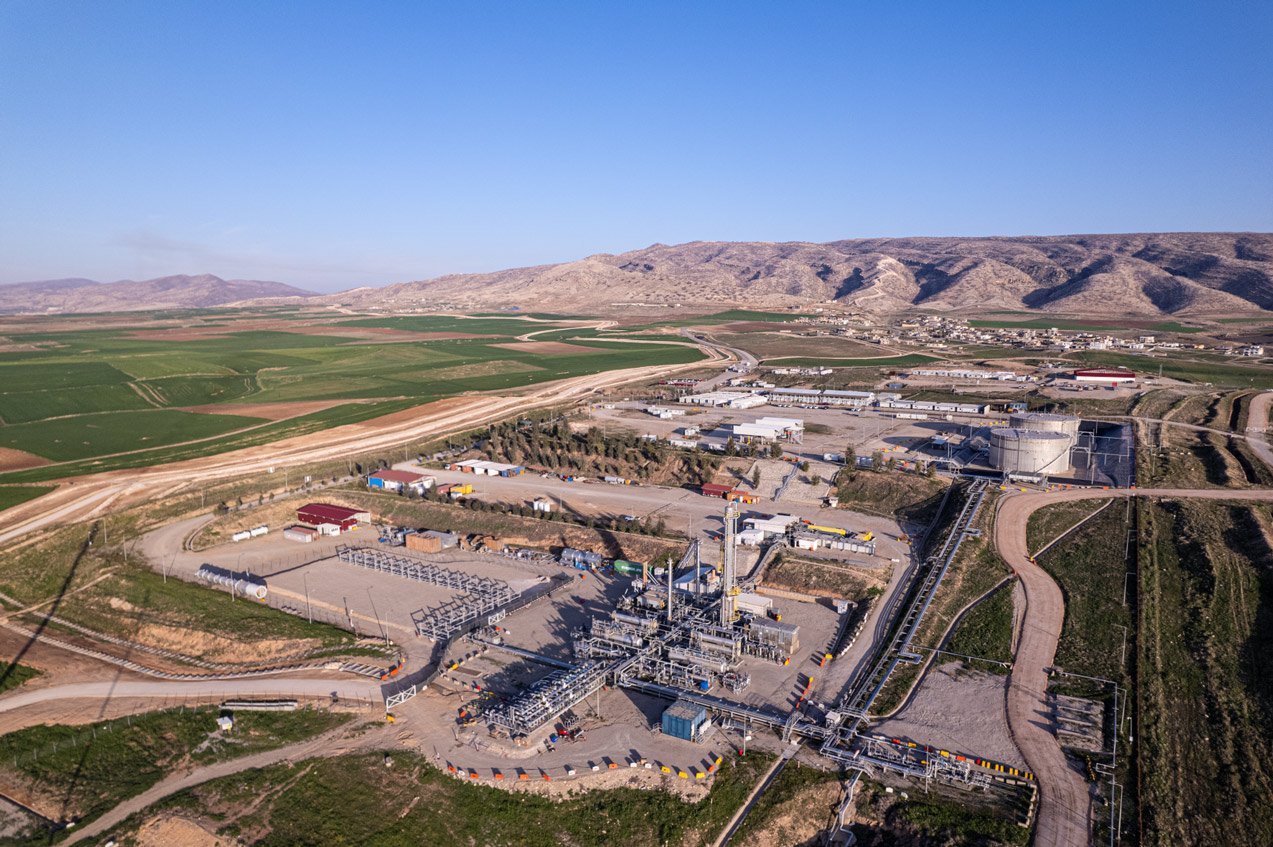
Oil production from the KRG’s Shaikan field, located northwest of Erbil, remained strong during the first half of 2025, particularly in the first five months, averaging more than 46,500 barrels per day. In June, however, output fell to 31,800 barrels per day on average due to reduced loading and sales during the Eid al-Adha holiday and disruptions caused by the 12-day Iran–Israel war.
Production rebounded at the start of July, but shortly after, drone strikes targeted nearby fields such as Sarsang, Ain Safni, and Tawke (Peshkhabur–Tawke). As a precaution, Gulf Keystone halted operations at Shaikan, pushing July’s average output down to 21,200 barrels per day.
By early August, production had resumed in coordination with the Kurdistan Regional Government (KRG). Between August 1 and August 26, average output was 39,600 barrels per day, with production since then returning to full field capacity.
Overall, output in the first half of 2025 rose 12% year-on-year, averaging 44,100 barrels per day compared with 39,252 in the same period of 2024. This increase was driven by both strong domestic demand and stable reservoir performance.
However, if the first eight months are considered, average output is lower due to the June war disruption and the July shutdown. From January through August 26, total production exceeded 9.6 million barrels, averaging 41,638 barrels per day.
Currently, production is back at full field capacity of 45,000 barrels per day, with PF-1 contributing 26,000 barrels and PF-2 contributing 19,000 barrels.
This report is based on data from Roonbin Organization, which specializes in KRG oil transparency through detailed analysis of company filings, production sharing contracts, financial reports, and verified field data.
Monthly Production of Shaikhan Field
January 1, 2025 – August 26, 2025
| Summary | Average Daily Production | Total Production |
|---|---|---|
| Total (Jan 1 – Aug 26, 2025) | 41,638 barrels | 9,671,700 barrels |
Revenue Analysis
Revenues rose sharply in the first five months of 2025, driven both by higher production levels and by an increase in oil prices.
Shaikan crude sold at an average of $27.8 per barrel during the first half of the year, a six percent rise compared with $26.3 in the first half of 2024. Even so, the field’s oil continued to trade at a deep discount, averaging $44.1 below Brent crude, which stood at $71.9 per barrel during the same period. (Kurdistan oil is not directly tied to Brent, but the comparison illustrates the gap in market value.)
Total production in the first half amounted to 7,984,900 barrels, generating $221,980,220 in sales revenue. Of this:
- – Gulf Keystone’s share was $83,144,200, up 17 percent from $71,186,000 in H1 2024.
- – MOL’s share was $15,982,576.
- – The Kurdistan Regional Government retained $122,853,444.
From January through August 26, total production reached 9,671,700 barrels with $268,873,260 in sales revenue. During this period:
- – Gulf Keystone’s share was $100,708,307.
- – MOL received $19,358,875.
- – The KRG took $148,806,078, representing 55.4 percent of the total.
Operational Costs and Capital Investment
Operating costs rose by 13% in the first half of 2025, reaching $26,893,000 compared to $23,917,000 in the corresponding 2024 period. This increase primarily reflects higher production costs and expenses associated with returning two wells to active service. Despite the cost increase, the per-barrel production cost remained stable at $4.4, unchanged from 2024 levels, demonstrating effective cost management amid increased production volumes.
Capital expenditure surged significantly to $18.1 million, up from $7.8 million in 2024. These investments focused on upgrading the PF-2 treatment facility and optimizing production efficiency. The company projects capital expenditure for the full 2025 year to range between $30-35 million.
In terms of shareholder returns, Gulf Keystone distributed $25 million in interim dividends during the first half, with an additional $25 million scheduled for distribution on September 30. This brings total declared dividends to $50 million, equivalent to 11.52 cents per ordinary share based on the company’s issued share capital as of August 27, 2025.
Shaikhan Field Revenue Distribution
First 8 Months of 2025
| Item | First 6 Months 2025 | First 8 Months 2025 | Percentage % |
|---|---|---|---|
| Total Production (barrels) | 7,984,900 | 9,671,700 | – |
| Avg. Price Per Barrel | $27.8 | $27.8 | – |
| Total Revenue | $221,980,220 | $268,873,260 | 100% |
| Gulf Keystone (GKP) Share | $83,144,200 | $100,708,307 | 37.4% |
| MOL’s Share | $15,982,576 | $19,358,875 | 7.2% |
| KRG’s Share | $122,853,444 | $148,806,078 | 55.4% |
Infrastructure Development
A significant infrastructure development decision involves the planned establishment of a water treatment facility at PF-2, scheduled for implementation in early 2027. Once operational, this facility is projected to add between 4,000-8,000 barrels per day to overall production capacity while mitigating reservoir management risks.
Current Sales and Distribution
With exports via the pipeline remaining suspended, Shaikan crude is now sold exclusively to domestic purchasers at discounted rates. The primary buyers consist of Kurdistan Region refineries, with oil loaded via tanker at the field’s loading facility. The company maintains a cash-on-delivery policy, requiring advance payment before each shipment.
During the first half of 2025, three major buyers dominated purchases of Shaikan crude, though specific market share percentages were not disclosed in the available data.
Outstanding Financial Obligations
The relationship between the operating companies and the KRG remains complicated by significant outstanding financial obligations. Gulf Keystone and its partner MOL (collectively “the Contractors”) are owed a combined $192.8 million, comprising $150.5 million in cost oil recovery and $42.3 million in profit oil entitlements for the period from October 2022 to March 2023.
Gulf Keystone’s individual exposure totals $151.1 million, consisting of $120.4 million in cost oil and $30.7 million in profit oil (after deducting capacity building payments). The company continues to pursue full recovery of these outstanding amounts through ongoing dialogue with the KRG.
Export-related commercial obligations total $171.0 million, based on Kurdistan Blend crude pricing mechanisms established by the KRG at $158.8 million for the October 2022 to March 2023 period. This figure includes $12.2 million in Shaikan field debt that Gulf Keystone acquired from Kalegran, a MOL group subsidiary.
The debt structure operates through two mechanisms: cost oil recovery, allowing companies to recoup operational expenses, and profit oil sharing between the companies, MOL, and the Kurdistan Regional Government. MOL’s total outstanding balance stands at $42.7 million, split between $30.1 million in cost oil and $11.6 million in profit oil.
Disputed Commercial Terms
A separate financial dispute involves $83.7 million in amounts Gulf Keystone claims are owed by the Kurdistan Regional Government, up from $80.8 million in 2024. These disputed amounts are considered unlikely to be resolved through unilateral cash settlements.
The dispute centers on two primary issues: $40.9 million (2024: $40.1 million) that Gulf Keystone expects to offset against oil sales to the KRG through 2018, and $42.8 million (2024: $40.8 million) related to capacity building payment rate discrepancies.
Summary of Debt from the KRG to the Company
| Item | As of 30 June 2025 (Unaudited, in thousands USD) |
As of 31 Dec 2024 (Audited, in thousands USD) |
|---|---|---|
| Amounts due from the KRG not expected to be received in cash | 83,722 | 80,905 |
| Capacity building payments to be offset against KRG trade payables | 7,687 | 7,687 |
| Total Government Debt to the Company | 91,409 | 88,592 |
The capacity building payment controversy stems from differing interpretations of contractual terms. While the current rate stands at 20% based on entitlement principles approved since October 2017, Gulf Keystone argues this should be 30% under the 2016 bilateral agreement, previously 40%.
Gulf Keystone maintains that under the original 2016 bilateral agreement terms, the company’s operating profit share should be 80%, compared to the current 61.5% payment basis. The company believes that if commercial terms fully revert to the original Production Sharing Contract (PSC) and 2016 bilateral agreement, it should receive compensation exceeding the $42.8 million currently recorded as accumulated expenses.
Export Resumption Prospects
Gulf Keystone claims its ready to restart pipeline exports once a written agreement addresses the recovery of outstanding financial entitlements and past debts, while recognizing existing commercial rights under KRG contracts.
The company argues that resuming exports would create mutual benefits: Gulf Keystone would achieve higher revenues through international pricing, while Iraq would similarly benefit from increased revenue streams.


