


A Gas Field in Kurdistan Becomes a Front Line in the U.S.–Iran Energy War
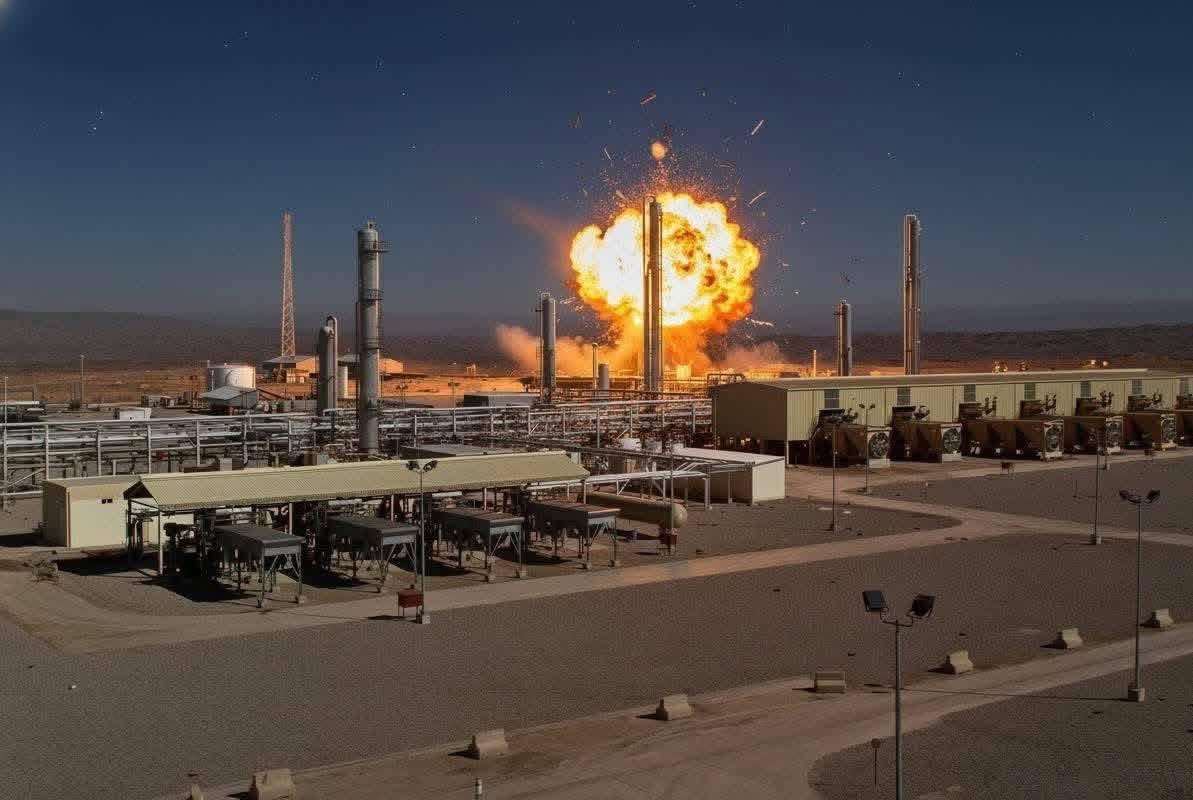
The 26 November combined drone-and-rocket strike on the Khor Mor gas field in the PUK-controlled Chamchamal district of Sulaimani is the most serious in a string of more than a dozen attacks on the field in recent years. The repeated and increasingly sophisticated targeting of Khor Mor – the largest gas field in both Kurdistan and Iraq – represents a calibrated assault on the hardware of a new Kurdish gas architecture that is slowly but fundamentally altering Iraq’s internal energy balance. This emerging infrastructure threatens Iran’s entrenched interests in the Iraqi energy market even as it is quietly groomed for future expansion to Turkey and, potentially, Europe.
Context: Despite early rumours of catastrophic damage, the 26 November attack was surgically targeted. Gas production units and gas storage facilities were not directly hit. Instead, the strike destroyed a very large, newly built naphtha storage tank with a capacity of around 160,000 barrels. The blast forced a full shutdown of production until yesterday. On paper, this looks like a second-order hit – a liquids tank rather than the core gas processing trains. In practice, it was a strike at the heart of Khor Mor’s operating logic.
At Khor Mor, gas and naphtha (condensate) are co-produced. Without safe naphtha storage, gas production cannot continue at scale. By knocking out the new tank, the attackers effectively flipped a switch on the entire field. The timing was not accidental. Roughly six weeks before the attack, the KM250 expansion project at Khor Mor was completed, raising output to around 750 million standard cubic feet per day. That upgrade significantly increased Khor Mor’s weight in both the Kurdistan Region’s electricity mix and Iraq’s wider power equation.
When the field is shut down, the Region loses more than 80% of its gas-fuelled power generation. Officials estimate that 65–70% of total electricity output is directly tied to Khor Mor’s gas. Each attack therefore produces not only local blackouts but also ripples across the federal grid, as power plants scramble for replacement fuel. Gas from Khor Mor also underpins around 1,700 megawatts of electricity exported to Iraq, as well as feeding Kirkuk’s gas power plant, further amplifying the shock when the field goes offline.
Analysis: The significance of Khor Mor cannot be understood in isolation from the new pipeline map that has taken shape between 2008 and 2025, and from the political geography of who controls what. The field itself sits deep in PUK territory, in Chamchamal, while the KDP dominates the KRG cabinet and the Kurdistan Region’s presidency and previously spearheaded oil exports through Turkey. The KDP’s leadership wanted to replicate that model with natural gas, building out infrastructure that could, in time, send Kurdish gas north through Turkey and on to Europe. PUK president Bafel Talabani opposed a rush toward direct gas exports and found an ally in Washington, which preferred a more contained model: use Kurdish gas primarily to generate electricity for domestic needs, then sell surplus electricity into Iraq rather than exporting raw gas.
The pipeline network now under construction reflects this compromise and its potential evolution. Since 2007–2008, a 24-inch gas pipeline has connected Chamchamal to Erbil. In recent years, work has begun on a second line along the same route, slated for completion by the end of this year which is being built jointly by KDP-backed KAR Group and PUK-backed Natron Group, with a third due to start in the spring. Chamchamal is linked to Qaiwan’s Bazyan power station, one of the Region’s key gas-fired plants, and to the Kirkuk field, tying Kurdish gas into federal infrastructure. From Khor Mor, gas flows to Chamchamal and then onward to Erbil, and from Erbil a large-diameter pipeline already runs to Duhok, with plans to double the Erbil–Duhok capacity so that two lines serve the northwestern governorate.
The next major step is a 36-inch pipeline from Chamchamal to Erbil with a capacity of about 1.5 billion cubic feet per day – roughly two and a half times the throughput of the 24-inch line. Its design allows additional gas flows to be connected from Kirkuk and Mosul, turning Chamchamal and Erbil into a potential regional hub rather than a simple end-point consumer. Crucially, the companies laying these lines include one close to the KDP and another close to the PUK, underscoring that this is, at least on paper, a joint Kurdish strategic project rather than the monopoly of one camp. Industry estimates suggest that the Kurdistan Region’s gas reserves comfortably exceed domestic demand, enabling it to run large power plants, cover the needs of Erbil and Duhok beyond Sulaimani several times over, and still generate a surplus that can be monetised – initially as electricity sold into Iraq, and later, potentially, as exported gas.
This is the geoeconomic core of the story: the Kurdistan Region is quietly moving from being “just” an oil exporter to becoming a gas-based power and transit player plugged into Iraqi and potentially regional demand. That shift collides head-on with Iran’s position in Iraq’s energy market. As one senior KRG official put it bluntly, Iran will not allow Kurdish gas to become a substitute for Iranian gas to Iraq. Tehran has been selling, until recently, substantial volumes of gas to Iraq for power generation. Those exports have provided hard currency at a time of suffocating sanctions and, just as importantly, a direct leverage tool over Baghdad, with gas cut-offs translating quickly into blackouts and political pressure.
From Tehran’s perspective, any project that meaningfully raises Kurdish gas output, more tightly integrates Khor Mor and Chamchamal into the federal grid, or suggests that Baghdad could one day rely on Kurdish molecules instead of Iranian ones is a direct threat to that revenue stream and leverage. The US, meanwhile, has tightened enforcement of sanctions in ways that increasingly constrain Baghdad’s ability to keep paying for Iranian gas. Washington does not want Iraqi state collapse or chronic instability, but also does not want to ease the pressure on Tehran. Supporting Kurdish gas-fired electricity is the way to square that circle: keep Iraq’s lights on while slowly undercutting Iran’s energy leverage.
This entire episode therefore sits on top of a wider strategic reframing that began with the Ukraine–Russia war. At the outset of that conflict, Kurdish leaders openly floated the idea that Kurdistan’s gas could help compensate for European shortfalls and provide an alternative to Russian gas. The backlash was swift: the home of KAR Group’s CEO, Sheikh Baz in Erbil was targeted by Iran, and he retreated from the idea of fast-tracked gas exports; Iran has been a Russian ally in the Ukraine war. Washington then moved toward a more politically manageable formula: use Kurdish gas to generate electricity locally; sell that electricity into Iraq’s national grid to gradually reduce Iraq’s dependence on Iranian gas; and, in parallel, keep the possibility of future exports to Turkey and Europe alive without prematurely advertising “Kurdish gas to Europe” as an immediate reality.
The visit of the US Assistant Secretary of State for Energy Affairs to Erbil last year – and his meetings with KAR CEO Sheikh Baz, Mass Group CEO Ahmad Ismail, and Qaiwan CEO Sheikh Fakhir, the Region’s leading electricity sellers to Iraq – underline that Washington now sees Kurdish gas-fed power as a strategic asset in its broader confrontation with Iran. From the US vantage point, the logic is simple: stabilise Iraqi electricity, dilute Iranian energy leverage, and keep a Kurdish gas option in reserve for a Europe that, since the invasion of Ukraine, has been trying to wean itself off Russian gas and diversify toward multiple suppliers, including potential east–west corridors running through Turkey, into which Kurdistan’s gas could eventually be plugged.
Seen this way, the Khor Mor attack is not a random act of sabotage but a coercive message. The Region may expand gas production for local use, but any step that looks like functional substitution of Iranian gas in the Iraqi market, or like a serious move toward export routes that could eventually feed European demand, will be met with escalation. That logic also explains why the attackers did not simply harass the field with minor damage but chose to knock out a specific element that maximises leverage with minimal visible destruction: a single tank whose loss forces a full shutdown, strands the new KM250 expansion and maximises political shock in both Erbil and Baghdad.
Between now and mid-2026, several critical milestones converge: completion of the Chamchamal–Khor Mor pipeline, fully integrating the field into the broader network; commissioning of the second Chamchamal–Erbil line and the start of the third; progress on the second Erbil–Duhok pipeline, further expanding northern capacity; and the consolidation of Khor Mor’s upgraded production as it feeds major power plants in Erbil, Duhok, Chamchamal and Bazyan. For Erbil, these are the birth pangs of a new energy order in which the Region is no longer just an oil exporter but a gas-based power hub, Baghdad’s reliance on Kurdish gas-fired electricity gives the KRG new bargaining chips, and Iran faces a slow erosion of its near-monopoly on gas supplies to Iraq.
For Iran-aligned militias and their political patrons, the same process looks like the gradual construction of an energy architecture that erodes their influence. Repeated strikes on Khor Mor are their way of insisting that no new order will be built without their consent or without a price. And for the Kurds, the central question is whether they can translate geological endowment into durable leverage without being crushed in the crossfire between Iranian red lines, Iraqi factionalism and the cautious limits of Western protection – at the very moment when Kurdistan’s gas is becoming a frontline asset in the US–Iran struggle over Iraq and, increasingly, over Europe’s post-Russia energy landscape.


