


China Quietly Builds a Cultural Beachhead in the Kurdistan Region
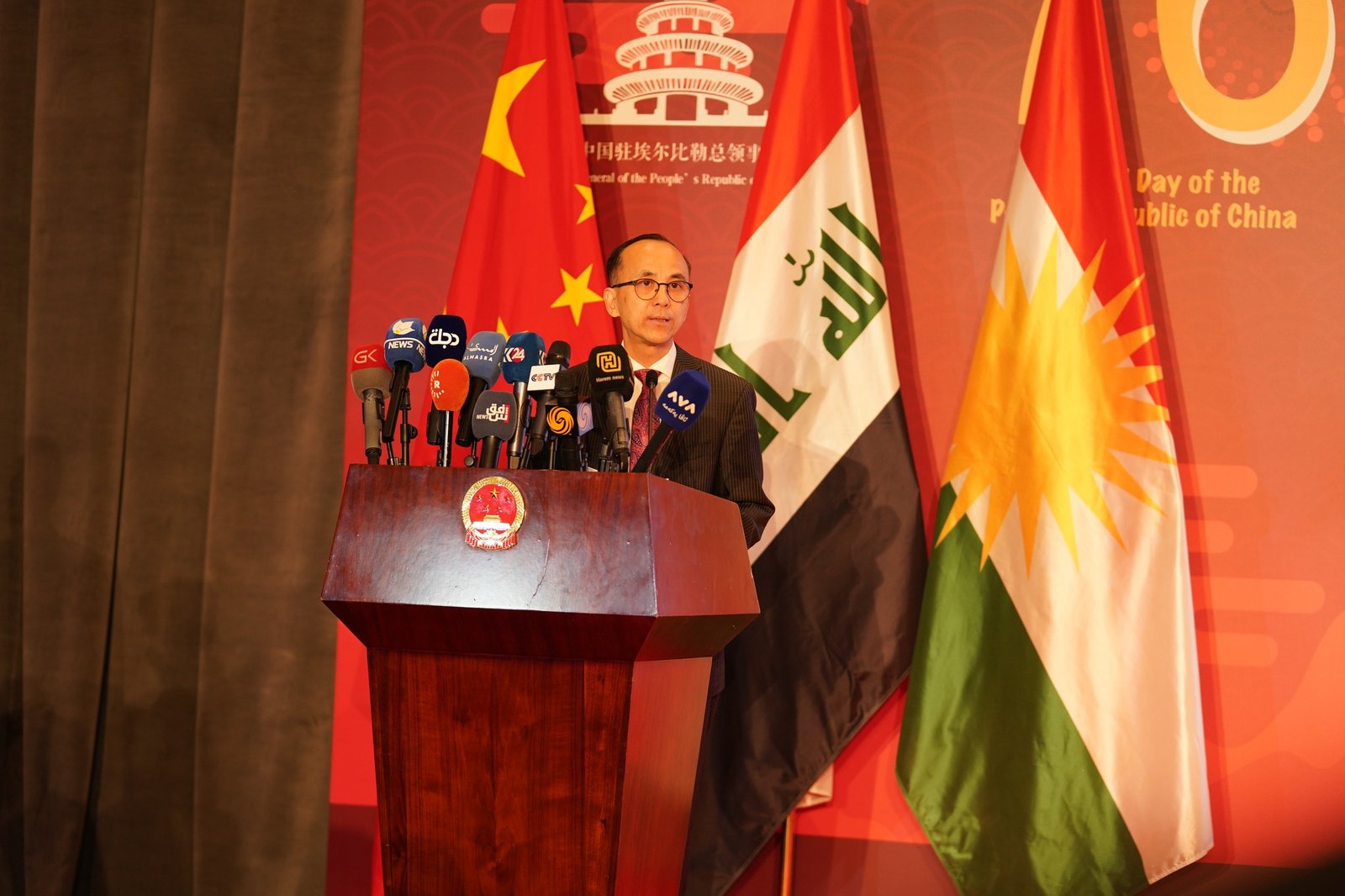
China is quietly building cultural institutions in the Kurdistan Region, following a pattern seen in other parts of the world. Over the past two months, Beijing has partnered with the Communist Party of Kurdistan to establish an Erbil-based think tank, is preparing to support a second research center in Sulaimani with a local academic institute, and is laying the groundwork for an alumni network of more than 500 people who have previously been invited to China.
Context: Recent Chinese initiatives have included the regular invitation of journalists, researchers, and academics from Iraq and the Kurdistan Region. More than 900 people have already taken part in training programs and study tours focused on China’s political system and cultural model.
In Erbil, a research center established by the Communist Party of Kurdistan in cooperation with the People’s Republic of China has begun operating, publishing a magazine as its first initiative. The center is named the Global Civilization Initiative Center. A second China-backed research center is expected to open soon in Sulaimani in partnership with an academic institution.
Another initiative, due to be announced by the Chinese consulate in Erbil, is a network called the Grand Wall, which aims to enroll all residents of the Kurdistan Region who have been invited to and visited China as members.
Analysis: China has been sending growing numbers of Kurdish and Iraqi journalists, activists, parliamentarians, businesspeople, and officials on tours and training programs. In its dealings with Iraq and the Kurdistan Region, Beijing publicly distances itself from overt political engagement and instead emphasizes cultural, academic, and service-oriented activities. The stated goal is to familiarize Iraqis and Kurds with Chinese language, culture, heritage, and the “Chinese model.”
This strategy appears to be having some impact on local discourse. After returning from China, journalists and activists increasingly discuss and promote aspects of the Chinese model on social media. For example, Hemin Bakir, editor of the Sulaimani-based news site Diplomatic and a former invitee to China, has written multiple pieces expressing his fascination with the Chinese experience.
The practice of inviting diverse societal stakeholders—journalists, academics, civil society actors—for curated visits is well established among Western states, particularly the United States. For China, however, this level of sustained outreach is relatively new in the Kurdistan Region. What is even less tested locally is the establishment of China-backed research centers embedded in local political and academic structures.
Kawa Mahmoud, former Secretary of the Central Committee of the Communist Party of Kurdistan and director of the Global Civilization Initiative Center, notes that China has allocated a specific budget for the initiative and that their cooperation will focus primarily on research. He says the partnership will involve joint work on publications, conferences, and seminars, alongside the center’s own magazine.
Although China frames these initiatives as apolitical and distinct from what it sees as Western-style political interference, they clearly carry a political dimension. In academic terms, they fit squarely within the established concept of “soft power” projection. At the same time, China has pursued flagship economic projects meant to showcase its presence in the Kurdistan Region—most notably the planned $5 billion “Happy City” tourism and residential complex on the outskirts of Erbil, promoted by a Chinese investor as one of the region’s largest foreign direct investments. Yet despite years of marketing and formal approval, Happy City has remained stuck at the pre-construction stage, with no foundation stone laid and no visible progress on the ground, becoming shorthand in local analysis for stalled foreign investment. U.S. officials have in the past used their leverage to convince the KRG to hold off on advancing the project, and some reports describes Beijing as being at odds with leading Barzani networks over the fate of the scheme—illustrating how Chinese ambitions in Erbil are constrained by both American pressure and intra-Kurdish political calculations.
Beijing’s overall priority in Iraq, however, remains the federal level rather than the Kurdistan Region alone. While KRG oil exports are directed mainly toward Europe and now also the United States, southern Iraqi oil is one of China’s main energy sources, accounting for an estimated 11–13 percent of China’s energy supply. Moreover, no Chinese companies operate the main KRG oil fields, whereas in federal Iraq Chinese firms are estimated to account for over 7 percent of oil production, compared with around 2 percent produced by U.S.-based companies.
In relation to disputed territories that lie within the broader Kurdish sphere of influence, China has also made moves. The Chinese oil and gas company GeoJade has been awarded a 35-year contract to develop natural gas in Khanaqin, a disputed area currently under federal Iraqi control but traditionally seen as within the PUK’s zone of influence. The company has begun operations in Khanaqin’s oil fields and, under its contract with Iraq’s Ministry of Oil, aims to turn the area into Iraq’s largest source of natural gas—effectively competing with the Khor Mor gas field in the Kurdistan Region, which is operated by UAE-based Dana Gas and is currently Iraq’s largest operational gas field.


