


The Kurdish Layer in Washington’s Iraq-Syria-Turkey Design
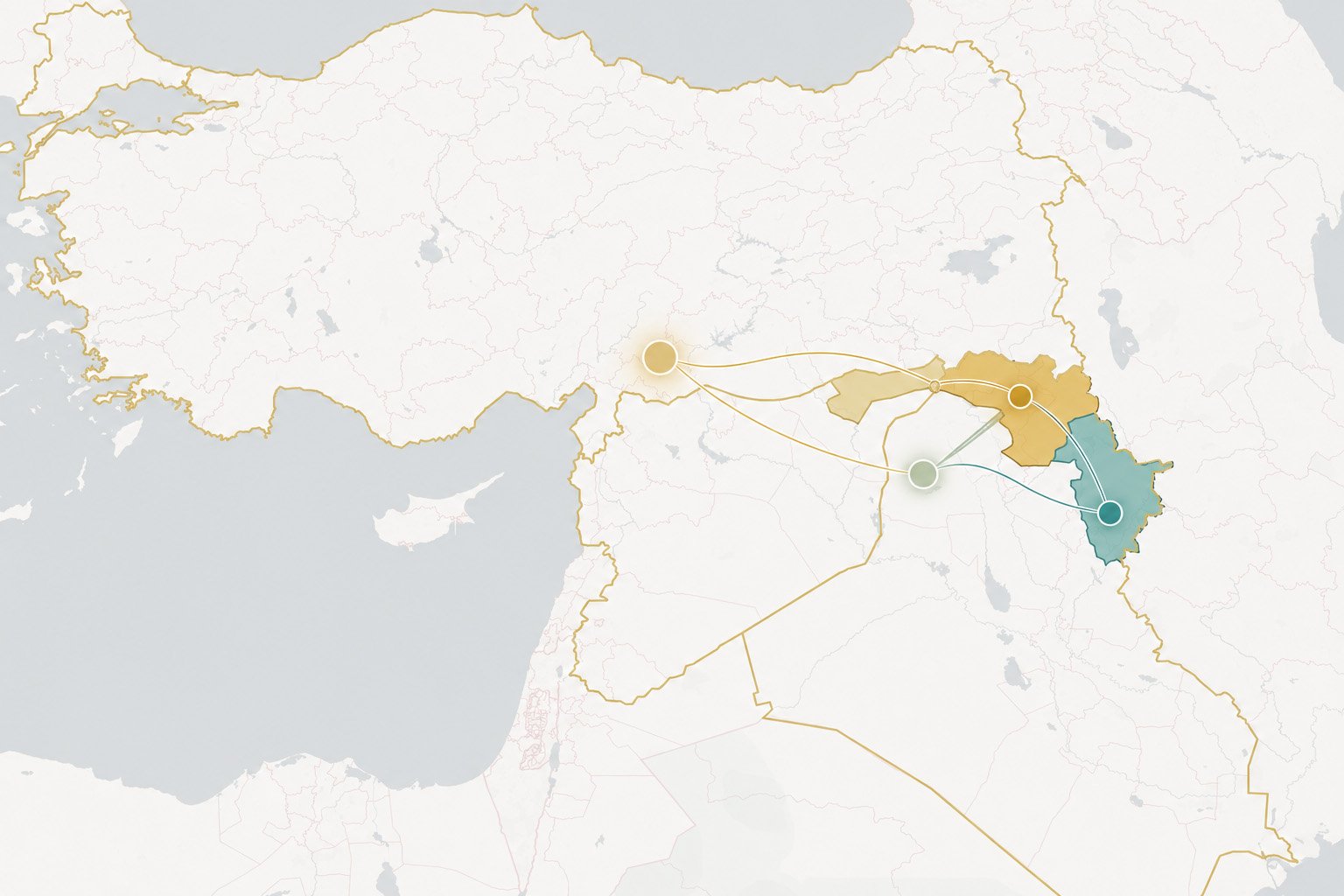
A new Middle East is taking shape, and its organising principles are trade and connectivity rather than military power alone. The order being built is state-anchored. For the first time, the Kurdistan Region has accepted a unified customs system under federal oversight, and its oil exports run through Iraq’s state marketer SOMO. But beneath that state layer, the KDP and the PUK are being brought in as partners in their own right: two separate local actors inside the new architecture, not two halves of one regional government.
Context: The National Context has proposed the Fulcrum Doctrine: a US-led Iraq-Syria, or Mesopotamian-Levantine, economic-security architecture that reads as the regional execution of the National Security Strategy the administration released in December. That document makes energy dominance and economic statecraft the instruments of American power in the Middle East, and treats the region as a destination for investment rather than a military burden. Barrack’s own appointment, ambassador to Turkey and envoy to both Iraq and Syria, put one person in charge of all three files, and the deals that followed, Chevron and HKN in Iraq, ConocoPhillips in Damascus, read as that strategy put into practice. Turkey is not one of three equal states in this design. It is the market, the transit hub and the security gatekeeper, and its peace process with the PKK decides whether Kurdish networks function as a connector or a threat. The method is infrastructure-based burden-shifting: leverage moves from holding territory to owning the systems that make territory function. Its purpose was set by the war with Iran and the closure of the Strait of Hormuz, which exposed how much regional energy depends on a single chokepoint, so the corridors now being built through Syria and through Turkey exist to remove that dependence. Assad’s fall in December 2024 is what made the Syrian corridor possible at all. The government that replaced him is aligned with Turkey, and that realignment is what lets Washington route Iraq’s connectivity through Syrian and Turkish territory instead of through Tehran’s reach, cutting into Iran’s influence over Iraq by a path that has nothing to do with Iraq’s own government.
Analysis: A new US approach is taking shape across these three countries, and it relies less on direct military power and more on connectivity, energy corridors, economic integration and regional burden-sharing. The strategy itself calls for shifting burdens to “sophisticated” nations expected to take primary responsibility for their own regions, a description that fits Turkey as well as it fits any American ally. Barrack’s cross-cutting portfolio reflects the same logic. These files are no longer treated as separate tracks. They are being synchronised around a common aim: reduce Iranian leverage, create alternative routes for trade and energy, and bind Iraq and Syria more closely to Turkey and to US-aligned regional networks.
This is happening alongside Turkey’s renewed peace process with the PKK, and Ankara’s own framing of that process matters. The final report of the parliamentary committee overseeing it, adopted in February with cross-party support, does not describe a terror-free Turkey as a domestic settlement. It presents the process as necessary for regional stability, invokes Saladin and Alparslan to frame Turks and Kurds as historic partners, and treats Kurdish populations in neighbouring countries as part of the same file. In this framing, Kurds across the region become a source of Turkish influence rather than a security liability. This is where the American and Turkish approaches overlap. They are not identical, but they are compatible.
In this emerging framework, Kurdish actors are becoming important nodes. They are not treated as one unified Kurdish bloc. They are dealt with as separate actors, each with a specific use.
In Iraq, this is clearest in the roles of the KDP and the PUK. Oil is concentrated mainly in the KDP zone, along with the established crossing at Ibrahim Khalil and the pipeline connection to Ceyhan. Gas, which is becoming more important, is concentrated almost entirely in the PUK zone. This gives both parties value, but it is raising the PUK’s importance, because gas now sits at the centre of the next phase of regional energy planning. Khor Mor’s processing capacity reached 750 million cubic feet a day after the KM250 expansion was completed in October 2025, output has already reached around 700 million, and the pipeline connecting the field to the Sulaymaniyah power plant was completed in late June, Kurdish-language outlets have reported. Chamchamal is the next step, with agreements signed to supply industrial buyers with up to 142 million cubic feet a day from the second half of 2027. This gas serves the anti-Iran logic twice. Inside Iraq it can displace the Iranian gas that still fuels roughly a third of federal power generation. Toward Turkey it is being positioned at the right moment: Ankara’s own gas contract with Iran, 9.6 billion cubic metres a year, expires this month.
The PUK is also becoming more relevant because of the peace process itself. In the earlier phase, when Turkey’s policy was built on military pressure against the PKK, the KDP was more useful to Ankara because of its hostility toward the PKK, and the PUK’s proximity to the PKK made it a problem: Turkey closed its airspace over Sulaymaniyah and shut the PUK’s office in Ankara. In the current phase, where the aim is political management and regional integration, that same proximity makes the PUK useful, because it can help manage the PKK-SDF-Turkey relationship the process depends on. This does not mean the PUK replaces the KDP. It means both are being used differently. The KDP remains central to oil, border access and Turkey’s established Kurdish network in Iraq, though even that role is narrowing: a first cargo convoy crossed from Turkey through Syria into Iraq in May, a Nusaybin-Qamishli-Rabiya-Mosul rail line designed to avoid Kurdish territory is the next stage, and Baghdad has approved feasibility studies for pipeline routes from Basra through Haditha toward both the Turkish and Syrian coasts. The PUK, meanwhile, is becoming more central to gas, Sulaymaniyah’s political channels, and the management of PKK-linked files.
The same pattern applies more widely. Kurdish actors are not state anchors, but they function as regional connectors. They sit between Iraq, Syria and Turkey, and they provide channels that states either cannot use directly or prefer not to use openly. This is why key Kurdish files run through Erbil and Sulaimani rather than only through state capitals. When SDF commander Mazloum Abdi needs to discuss the future of Syria’s Kurds with Washington, the meetings happen in Iraq’s Kurdistan Region: Masoud Barzani hosted Abdi and Barrack at his residence in Pirmam in January, Bafel Talabani received them near Sulaymaniyah in February, and Nechirvan Barzani did the same in June, the Kurdistan Region Presidency confirmed. The PKK’s disarmament ceremony took place near Sulaimani. The machinery behind these venues also exists on paper: Washington and Ankara run a standing US-Turkey Syria Working Group, with Barrack in the room. Barrack led the negotiations that pushed the SDF toward absorption into Damascus’s army, saying there is only going to be one nation state the United States will deal with, and calling himself an admirer of the Turkish peace process. Erdogan closed the loop in June, telling his party’s parliamentary group that the problem in northern Syria had been one of the biggest obstacles to the peace process and that it had now largely been resolved. He credited Damascus in public. The negotiating happened inside the working group.
There is also a historical echo here. The Ottoman order dealt with Kurdish power through multiple local dynasties and rival centres rather than through one unified Kurdish authority. A similar pattern is visible today. Kurdish actors are again being handled as separate power centres, each useful for a different route, asset or political channel.
This also explains why the Kurdistan Region’s two-year cabinet deadlock draws so little outside pressure. Oil moves from KDP fields regardless of who sits in the cabinet. Gas will move from PUK fields on the same basis. Both parties’ forces are trained and funded directly, and each carries a Turkey-facing file the peace process has made valuable. A reunified regional government is a preference for outside actors, not a requirement, and neither party has offered the concessions that forming one would need.
The design carries one open contradiction, and it surfaced this week. Weakening Iran strengthens Turkey. At the NATO summit in Ankara on Tuesday, Trump called Turkey an extraordinary ally and signalled he would lift the ban on selling it F-35 fighter jets. Netanyahu told CNN the same day that the sale would destroy the regional balance of power, and the US defense secretary’s planned meeting with him on the issue was then cancelled on Wednesday. The question after Hormuz is no longer whether Iranian leverage falls. It is who takes the space Iran leaves, and Israel does not want the answer to be Turkey.
The result is that Kurds are becoming one of the connective layers of the new regional order. The main strategy is connectivity: roads, pipelines, trade routes, gas, ports and political corridors. Kurdish actors are among the links that make this possible. They are not the architects of the order, but they are becoming part of the structure that holds Iraq, Syria and Turkey together inside it.


