


What a Grand Mosque Reveals About Why Kurdistan Can’t Form a Government
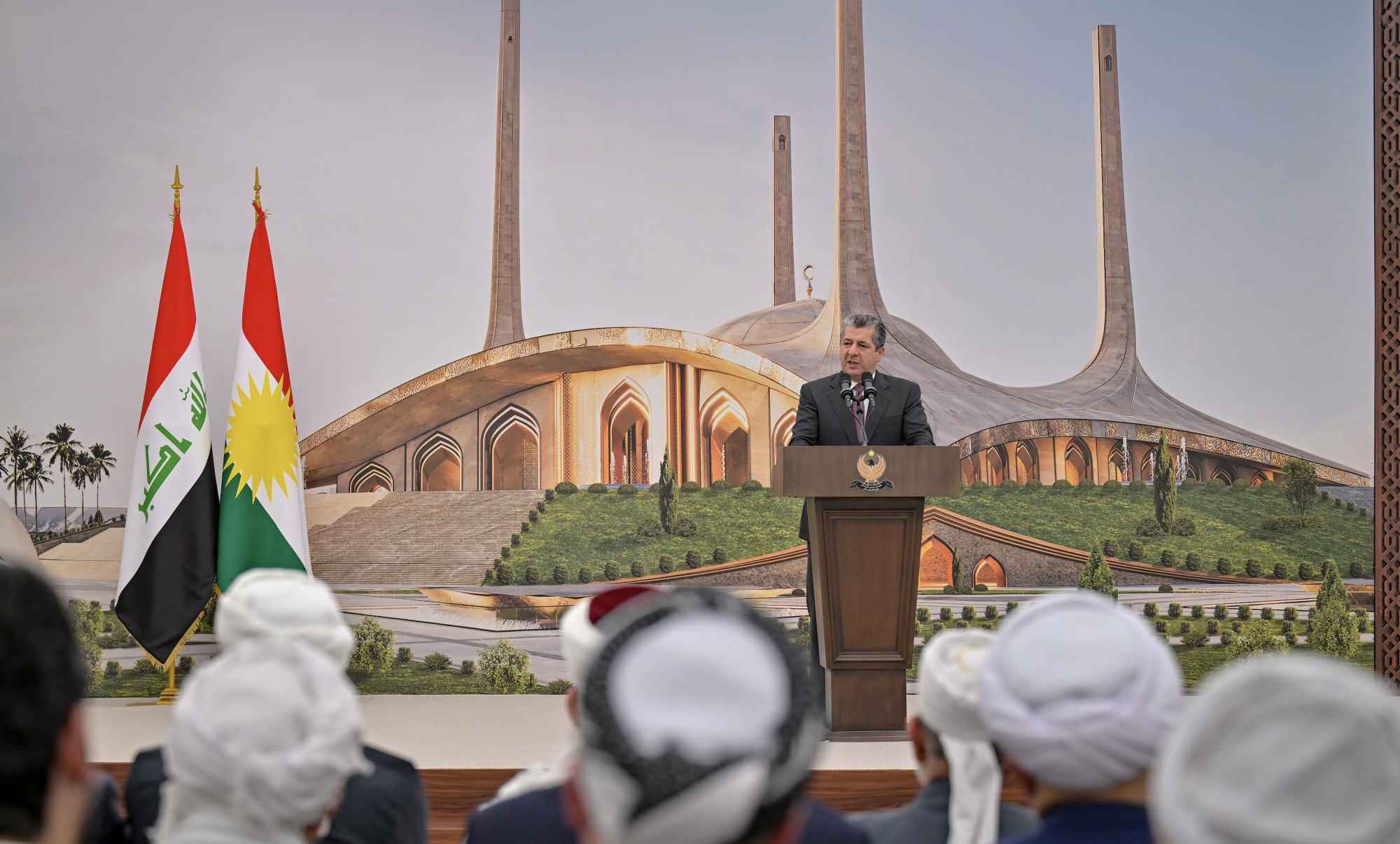
Masrour Barzani’s grand mosque borrows the language of Gulf monarchy and the personal ambitions of Mohammed bin Zayed. Read closely, it also explains why the Kurdistan Region still has no government.
On Sunday Masrour Barzani laid the foundation stone in Erbil for the Barzani Grand Mosque, a complex its planners claim will exceed two million square metres and which the Kurdistan Region’s prime minister described as a “historic necessity” for Erbil and Kurdistan. The building is named after the late Mullah Mustafa Barzani and is said to be modelled on the rashmall, the black wool tent of the region’s nomadic past, and it is presented as a monument to Kurdish heritage, faith and coexistence. It is also a catalogue of intended superlatives. According to the project, it will hold the world’s largest dome, the tallest gate, the largest handmade carpet and the largest sundial, with a prayer hall for some 9,000 worshippers and grounds designed for more than 700,000 people. Barzani told the ceremony that Erbil and Kurdistan needed a symbol to elevate the city’s standing in the world, and that the mosque would be, by surface area, the largest on earth.
What these choices amount to tells us more about Masrour Barzani than about the city they are meant to adorn. None of them is original. The family name on the building, the competitive scale, the vocabulary of civilisational ambition: each belongs to a template that already exists, the one Gulf rulers have used for half a century to convert a capital into a brand and a ruling family into a permanent national institution. To adopt that template is not merely to borrow an architectural fashion. It is to import a theory of what political authority is and where it comes from, and that theory is the real subject of the mosque.
The examples are not hard to find. The United Arab Emirates built the Sheikh Zayed Grand Mosque and named it for the federation’s founder. Oman built the Sultan Qaboos Grand Mosque and named it for its reigning sultan. Bahrain’s principal mosque carries the name of the founder of its ruling house. In each case the building performs the same political function. It fuses the ruler’s name, religious sanctity and national identity into one monument and plants it at the centre of the capital, where it stands as a permanent assertion that the family and the state are one. The Barzani Grand Mosque follows this logic precisely, with a single difference that makes it more dynastically ambitious than any of its models. “Sheikh Zayed” names one man. “Sultan Qaboos” names one man. “Barzani” names a bloodline. The word absorbs Mullah Mustafa, the family, and the household that governs today into a single inheritance, and sets that inheritance permanently in stone at the heart of Erbil.
Among these Gulf references, one sits closer than the others, and the connection is not just stylistic. Masrour visited the Sheikh Zayed Grand Mosque, has spent significant time within Emirati political culture, and first proposed this project in 2023, in the period that followed. Mohammed bin Zayed, the UAE’s president, is the heir who took his founding father’s name and made it into the permanent identity of the state, building national stature through monumental architecture, a consistent language of tolerance, coexistence and civilisational progress, and a relentless pursuit of superlatives and records. Masrour, son of Massoud and grandson of Mullah Mustafa, is doing the same thing with the Barzani name. The role he is reaching for is Mohammed bin Zayed’s: the modernising dynast who makes the ruling family and the state into a single thing.
This is what the mosque discloses about its patron. A man who builds a monument of this kind imagines himself as a sovereign, not as a temporary chief executive holding office on sufferance from a partner party and an electorate. He treats the Barzani name as coterminous with Kurdistan, his authority as a hereditary possession rather than a delegated mandate, and his tenure as something to be commemorated in granite rather than renewed at the ballot box. The decision to cast his rule in permanent form, at the very moment his mandate is contested and his cabinet does not exist, is the clearest possible indication of a self-conception that has detached from the institution he actually occupies.
The project’s architects understand that the Gulf comparison is obvious, and the tent is meant to refute it. By building the mosque around the rashmall, the supposed traditional Kurdish black wool tent, they present the design as proof that this is a Kurdish creation rather than another Gulf transplant. The claim does not survive scrutiny. The black goat-hair tent is a pan-nomadic form found across North Africa, the Middle East and Central Asia, and in fact, in the international imagination it reads first and most powerfully as Arab Bedouin. The most celebrated tent-shaped grand mosque anywhere is the Faisal Mosque in Islamabad, financed by Saudi Arabia, named for a Saudi king and consciously modelled on a Bedouin tent. A monumental tent-shaped mosque is, of all the forms available, the most unmistakably Gulf. The element meant to certify the building as Kurdish is the one that ties it most tightly to the tradition it claims to escape.


Set the symbolism aside, and the project still has to be assessed as what it is, a very large investment, and on those grounds it is indefensible. Scale is not a justification. Economics and political economy exist as disciplines precisely because resources are finite and every commitment forecloses an alternative, so the question that matters is never how large a project is but what it returns against what it costs and what it displaces. A mosque with the world’s largest dome is simply a very expensive mosque. Superlatives are an argument from marketing, not from value. The UAE could afford that argument because it was spending from a hydrocarbon surplus that left ample room for extravagance. The Kurdistan Region commands no such surplus. This monument is being launched by a caretaker cabinet in a territory that has repeatedly failed to pay its public servants on time, with no published account of what it will cost, what it will return, or why it should take precedence over the salaries and services that remain unmet. A project of this magnitude that cannot answer those questions has a plain name. It is an act of vanity.
It also fails on its own cultural terms, and Barzani’s stated justification makes this clear. He said at the ceremony that Erbil needed a symbol to elevate its standing globally. That is an argument for a city that lacks identity and needs one manufactured for it. Erbil does not fit that description. It is one of the oldest continuously inhabited cities in the world. The Citadel at its centre carries roughly 6,000 years of urban history. The Choli Minaret is a surviving monument of the medieval Muzaffariya complex. The historic mosque inside the Citadel is being restored as a religious landmark. Erbil does not need a new symbol. It has more accumulated identity than almost any city in the region. The Emirati playbook of manufacturing national symbols from scratch makes sense for a federation that came into existence in 1971. Applied to Erbil, it simply puts a fabricated landmark in competition with a genuine one.
Once the economic and cultural justifications both collapse, only one explanation for the project remains. It exists to express what Masrour Barzani believes about himself, and what it expresses is that he conceives of himself not as a prime minister presiding over a coalition but as a dynastic ruler in the mould of Mohammed bin Zayed.
This is where the self-image becomes a governing problem rather than an aesthetic one. Mohammed bin Zayed rules a hereditary autocracy. Authority in the UAE is undivided, hereditary, insulated from rival parties and unthreatened by elections; to govern there is to wield the concentrated power of a ruling house. To govern the Kurdistan Region is the reverse in every particular. It means presiding over a coalition of two parties with separate territories, separate security forces, separate revenue streams and a long inheritance of mutual distrust. Authority in such a system is shared by necessity rather than concentrated by right, and the prime minister is not the summit of a hierarchy but a party to a negotiation that never ends, obliged to persuade the other side rather than command it. The two arrangements are constitutional opposites.
The point cuts deeper than procedure. The very feature that disqualifies the UAE analogy is the feature that defines Kurdistan’s politics. The Region is not a single patrimony under one ruling house but a fragmented polity, divided among rival parties, competing security establishments and powerful families whose consent cannot be assumed. That pluralism is exactly why coalition is the only workable form of government, and exactly why the patrimonial model Masrour admires cannot be transplanted onto it. He is attempting to govern a divided society with the instincts of an undivided one.
This is the under-examined reason the Kurdistan Region has gone more than 600 days without a newly formed government. The surface disputes are genuine enough: which party holds which ministry, how revenues are apportioned, whether and how the premiership rotates. But beneath them lies a more fundamental obstruction. A leader who conceives of his authority as a hereditary right does not readily surrender ministries, accept rotation, or treat a rival as a structural equal whose agreement is indispensable, because none of those acts belongs to the conception of power he carries. The mosque and the unformed cabinet are the same self-image expressed in two media, one architectural and one political.
There is a further dimension to the choice of model, one that bears not on how Masrour governs but on where his ambitions leave the Region. He is not only copying the UAE’s architecture but attaching Kurdistan, symbolically and politically, to its orbit, at the precise moment that orbit has become a liability even for those inside it. The 2026 war with Iran exposed the limits of the Emirati project. The UAE was struck on its own soil, recast by Tehran from neighbour to hostile base, and left at odds with Saudi Arabia over its conduct, while analysts across the region described a state that had overreached and an alignment with Washington and Israel that had bought it risk it could not contain.
For the Kurdistan Region the difficulty is sharper still, because the UAE’s adversaries are not distant abstractions but the very powers that decide Kurdistan’s fate. Iran, which shares a long border with the Region and on whose tolerance much of its economy depends, now regards the UAE as an enemy. Saudi Arabia’s rivalry with Abu Dhabi has hardened into open friction. Turkey, the Region’s indispensable patron, may have reconciled commercially with the UAE, but that reconciliation sits atop a decade of contest for regional influence that has been managed rather than dissolved, and Ankara has every reason to resist a rival Gulf power cultivating its own clientele inside what it treats as its sphere. To align a vulnerable, landlocked region with a Gulf state that all three of its decisive neighbours regard with hostility or suspicion is not a gain in stature but a self-inflicted exposure.
The aspiration is unattainable in any event, because Kurdistan possesses none of the conditions on which the Emirati model rests. The UAE is a sovereign state, enriched by oil, relatively secured by its distance from any predatory neighbour, and free to choose its alignments. The Kurdistan Region is a constitutionally subordinate part of Iraq, reliant on Baghdad for its budget, wedged between two regional powers that police its conduct, internally divided among factions that cannot agree on a cabinet, and nearly a thousand miles from the Gulf it is trying to emulate. A polity in that position cannot become a junior Abu Dhabi. The most it can achieve by trying is to advertise an alignment it cannot defend and provoke the neighbours it cannot afford to alienate.
On its own, the grand mosque is easy to dismiss as extravagance, a vanity to be argued over in terms of cost and taste. Read as evidence, it is far more revealing. It is a statement, set in the most durable medium available, of how Masrour Barzani understands his own authority, and that understanding is mistaken in every direction at once. He is governing a coalition as though it were a dynasty, building the symbols of Abu Dhabi in a city that has no use for them, modelling himself on a ruler whose country, system and circumstances are the inverse of his own, and tethering an exposed Region to a distant power its geography will not let it follow. The mosque may in time be completed. The government, until the thinking behind it changes, may likely not be, and the Region will carry the cost of the misjudgement long after the dome is finished.


