


Ocalan’s Ascent to ‘Father of the Kurds’: The PKK’s Ideologue and ‘Semi-Divine’ Centre of Gravity
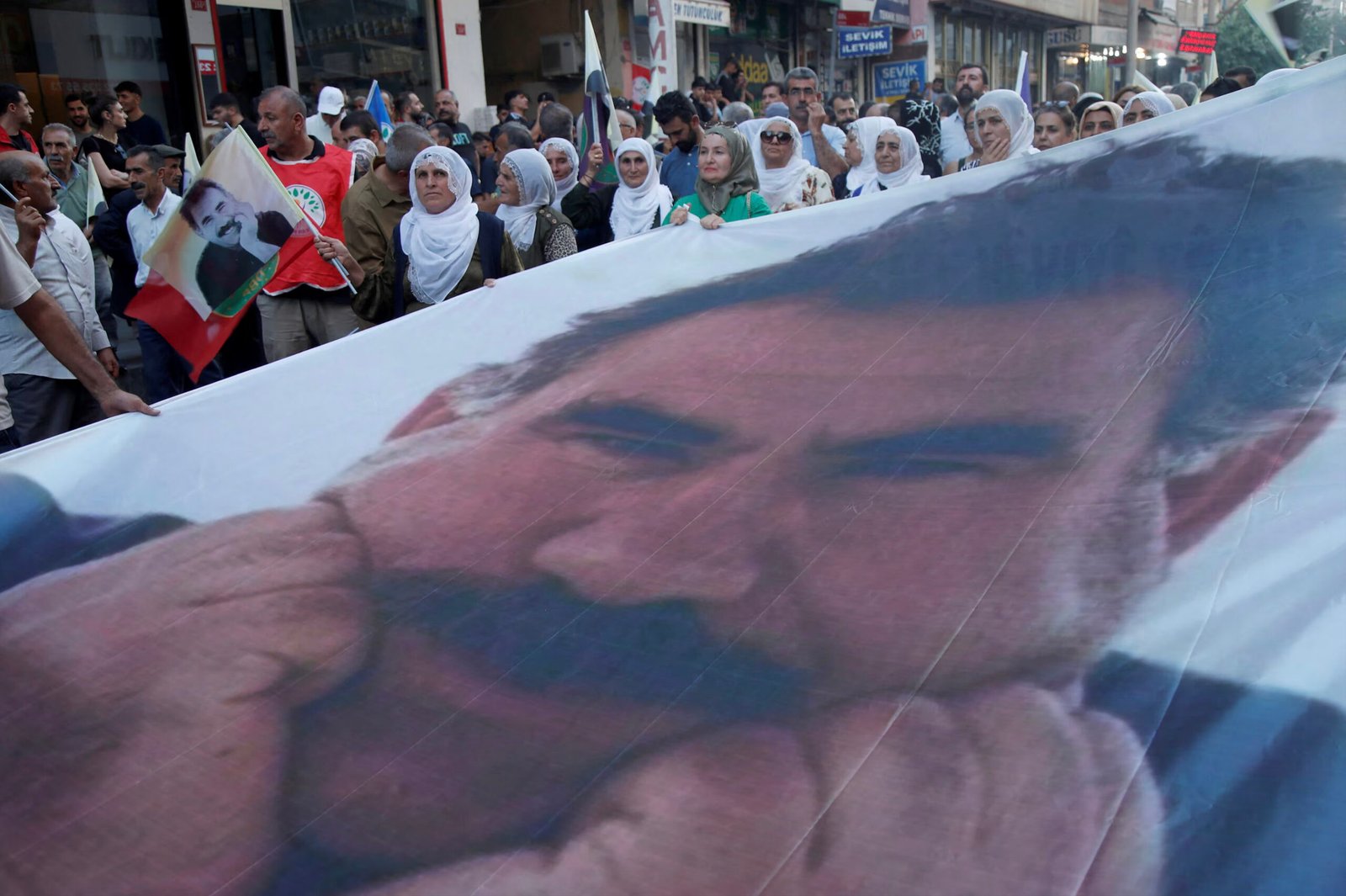
This past week, three MPs who together represent a majority in the Turkish parliament flew by helicopter to the island prison of İmralı in the Sea of Marmara and spent two hours and fifty minutes with the same man who has been held there for twenty-six years: Abdullah Öcalan.
Since 2005, Turkish intelligence has made this journey regularly. Kurdish MPs once went every fortnight. Generals conducted “interrogations” when the island was under direct military control. But this visit was different: it was the first by a delegation of the PKK–Turkey peace commission, a formal parliamentary body tasked with charting a legal and political end to the conflict. Faced with a Middle East in once-in-a-century upheaval, Ankara has quietly concluded that the man it once sentenced to death is now indispensable to its path of greatness in the region.
In the days before the visit, SDF commander Mazloum Abdi – whose forces control roughly a third of Syrian territory – put it bluntly: “Some issues can only be solved by İmralı. That is why, for the primary resolution of some problems, a relationship needs to be established between Rojava and İmralı. This is needed both for the solution process in Turkey and for resolving the problems in Syria. According to what they told us, Leader Apo also wants officials from Rojava to visit İmralı. We also feel a need for this.”
This week, activists from the Kurdistan Region of Iraq applied to Turkey’s justice ministry to meet Öcalan.
Inside Turkey, the signal has been even starker. Since taking point on the new peace track a year ago, Nationalist Movement Party (MHP) leader and key Erdoğan ally Devlet Bahçeli has repeatedly called Öcalan the PKK’s “founding leader” and “most serious interlocutor”.
His weight over the organisation was demonstrated earlier this year when he managed to dissolve the PKK with a single instruction, despite being behind bars for more than twenty-six years, proving how solid his influence remains.
Whether outsiders grasp it or not, the primary identity that binds PKK cadres across countries – an identity that often supersedes Kurdishness itself – is Apoism: being followers of Apo (meaning Öcalan). Öcalan is not simply a historical founder; he is the movement’s ideologue and its centre of gravity, treated by many supporters as a semi-divine figure whose authority renders rival currents of thought secondary.
The pattern is now hard to miss. Turkey’s parliament sends a commission. The SDF commander says “only İmralı can solve this”. Youth from Iraqi Kurdistan seek an audience. The state’s main nationalist leader openly names Öcalan as “founding leader” and key interlocutor. Taken together, these moves mark a shift: the Turkish state is now treating the Öcalan-centred universe – PKK, SDF, broader networks – as the indispensable address for Kurds, not only in Turkey but across the region.
Out of this, the rough shape of a deal is emerging. It remains fragile, reversible and vulnerable to spoilers. But the core is clear: Öcalan is elevated as patron and “father of the Kurds”, and in return he accepts a role as codified stakeholder in Turkey’s internal settlement and its wider regional architecture.
What Turkey Thinks It Is Buying
For Ankara – and especially for Bahçeli – this is not framed as capitulation to Kurdish nationalism, but as the move of a state that wants to end a draining conflict on terms that strengthen, not weaken, its power.
The strategic logic has three pillars.
First, the domestic insurgency. After almost half a century of on–off war with the PKK, it is clear the organisation cannot be completely eradicated, but it also cannot win militarily. Left unresolved, it drains resources and corrodes politics.
Second, the SDF corridor in northern Syria. For Ankara, the SDF embodies the PKK’s project in armed, territorial form. It sits along a long stretch of Turkey’s border, backed until now by the United States, and is viewed as both a security threat and a geopolitical lever in the hands of outside powers.
Third, and increasingly important, is the fear that Kurds become a permanent asset in an Israel-centred regional camp. From Ankara’s perspective, a fragmented Kurdish movement dependent on US protection and flirting with Israeli security ties is a ready-made card for others to play against Turkey. If Öcalan, the PKK and the SDF remain outside any Turkish-designed framework, they can be pulled more deeply into a Western–Israeli orbit; if they are pulled inside a Turkish-centred architecture, they become far less available as a hostile lever.
Turkey cannot simply annihilate the SDF without risking a protracted and destabilising war. Nor can it tolerate, indefinitely, a PKK-derived, US- and potentially Israel-leveraged army sitting on its frontier. The path being explored instead is to change the SDF’s status and patronage:
- integrating its forces into the new Syrian army and security institutions;
- stripping out, on paper at least, the overt PKK command spine;
- shifting its long-term horizon away from Washington and any Israeli security nexus, and towards a Turkey-centred regional order.
To make that transition stick, Ankara needs a figure whose word is binding across the PKK/SDF universe. That is what Mazloum Abdi meant when he said “some issues can only be solved by İmralı”. Without Öcalan’s call, integration could easily fracture the SDF and leave Ankara facing splinters rather than a manageable structure.
At the same time, Turkey wants to consolidate its internal front as it pushes outward. Bahçeli’s constant refrain that “Turks and Kurds are brothers” and that the only acceptable response to external turbulence is a “single fist” at home is not incidental. The idea is to keep the unitary state and its borders intact, but expand the circle of recognised stakeholders inside it. Kurds who accept the new framework – disarmament, civic citizenship, a re-imagined Turkish nation that includes them – become co-owners of the internal front. Those who reject it can more easily be marginalised or depicted as extensions of rival regional camps.
In net terms, Ankara believes it gains more than it risks. It ends a draining insurgency, neutralises the SDF as a hostile, foreign-backed border force, reduces the chance that Kurdish armed and political structures are pulled fully into an Israeli-aligned orbit, and replaces decades of internal fracture with a structured, if unequal, partnership – all while preserving the state’s unitary character and freeing up capacity for projection deeper into Syria and Iraq.
What Öcalan and the Kurds Think They Are Securing
For Öcalan and a large part of the Kurdish movement, the same formula looks like something else entirely: a chance to convert exhausted guerrilla war and a precarious autonomous pocket in Syria into de facto Kurdish unification and codified regional influence.
The elevation is not only symbolic. If the Turkish parliament, the SDF in Syria and activists from Iraqi Kurdistan all treat İmralı as the necessary address, then for the first time there is a single recognised leadership centre for Kurds in both Turkey and northern Syria. Borders remain on the map, but in terms of political gravity, a cross-border Kurdish space begins to cohere under Öcalan’s authority.
That was almost unimaginable until recently. Historically, Kurdish movements in different states have been fragmented by ideology, tribe, party and patronage. If Öcalan becomes the acknowledged “founding leader” in Ankara’s eyes, the indispensable interlocutor for the SDF and a figure whom other Kurdish actors feel obliged to consult, then the PKK universe is no longer merely a Turkish insurgent brand. It becomes a regional Kurdish axis, anchored in, rather than excluded from, a major state.
The Syrian track is central to this vision. As things stand, the SDF and the Autonomous Administration in the north-east amount to a besieged project: landlocked, dependent on US forces and permanently exposed to Turkish and regime pressure. If, under a deal blessed from İmralı, SDF forces are folded into the Syrian army and security services, their Kurdish cadres stop being a pocket on the edge of the state and instead become a lever inside it. Officers, intelligence networks and institutional expertise are spread through the system rather than confined to one strip of territory.
Where Ankara sells “integration” to its own public as containment, Öcalan can present it to his followers as diffusion and infiltration: not giving up gains, but redistributing Kurdish presence from a vulnerable enclave into the nervous system of the state itself.
The domestic track carries a similar logic. Öcalan has long argued that 1990s-style guerrilla warfare has reached a dead end – repetitive, costly, incapable of forcing decisive change. At the same time, he has moved away from a classic Kurdish nation-state project towards a vision in which Kurds become recognised partners within large polities rather than rulers of a small, landlocked mini-state.
In that frame, the emerging deal looks like an opportunity rather than a retreat. Inside Turkey, Öcalan ceases to be a ghost locked away offshore and becomes a codified stakeholder: the man whose assent is needed for major steps in the Kurdish file, and whom domestic and regional actors alike feel obliged to visit. Even if this begins in the form of heavily controlled house arrest or a ritualised İmralı, the effect is to turn his place of confinement into a kind of permanent political mecca – a site of pilgrimage, messaging and arbitration.
Across the region, this opens the door to something Kurds have lacked: a leadership centre not dependent on US troops or any single protector. If, as expected, the United States draws down, a Kurdish project built purely on American air power and a sliver of territory in Syria is extremely vulnerable. A Kurdish project anchored partly in a redefined Turkish system, with tentacles spread through Syrian institutions and connections into Iraqi Kurdistan, has a different weight.
For many Kurds, the choice then looks like this: remain guardians of a besieged, quasi-statelet at the mercy of foreign patrons, or become junior but entrenched partners in a larger, Turkish-centred regional order that they can also influence from within. Öcalan’s bet is clearly on the second.
Breaking with 1923
There is also an intellectual and symbolic dimension. What makes Öcalan distinct from earlier Kurdish leaders is not only his organisational grip, but his refusal to treat 1923, the founding year of the Turkish Republic, as the unquestioned beginning of history.
Where the Republic’s official story compresses everything into a single founding moment, Öcalan insists that Kurds and Turks shared a thousand-year “voluntary alliance” dating back to Manzikert, and that the last 100–150 years of nation-states fractured that alliance. In his recent writings, he has tried to move Kurds off the narrow terrain of “minority problem inside a nation-state” and onto a broader conceptual map: a world of civilisational states, multiple power centres and looser blocs.
In that world, he suggests, a Turkey that clings to a rigid ethnic definition of citizenship will remain permanently at war with a quarter of its own population and at odds with its geography. A Turkey that recasts itself as a broader civilisational state – with Kurds as constituent partners rather than a security problem – can project power far beyond its current reach. The price, from Ankara’s perspective, is widening the definition of who counts as a full stakeholder. The prize, from Öcalan’s perspective, is embedding Kurdish agency inside that larger project rather than watching from the margins.
A Bargain With Fragile Edges
None of this is foreordained. The risks are obvious on all sides. Ankara could bank disarmament and SDF integration and then stall on deeper reforms, leaving Kurds demobilised but dissatisfied. Öcalan’s own movement could fracture, with some cadres rejecting any deal that ties their fate so closely to a state they have fought for decades. Regional shocks – a major attack, a political crisis in Ankara, a breakdown in Syria – could reverse the calculus overnight.
But the direction of travel is clear enough. Turkey is exploring a way to tame and repurpose the Öcalan universe as part of a macro-Turkish regional order. Öcalan is trying to transform his role from the jailer of a single country’s insurgency into the architect of how Kurds fit inside that order – in Turkey, in Syria and beyond.
If the process holds, the result will not be a sentimental reconciliation but a hard, transactional pact: a unitary Turkish state that has expanded its stakeholders as it expands its reach, and a Kurdish movement that has traded the mountains and a besieged enclave for a permanent, if unequal, seat inside the architecture of power. At the heart of it all sits the same man on the same island – no longer just a prisoner, but the semi-divine centre of gravity around which both Kurdish politics and Turkish strategy now quietly revolve.


