


Turkey Moves to Finalise PKK Disarmament Law as Imrali Talks With Ocalan Conclude
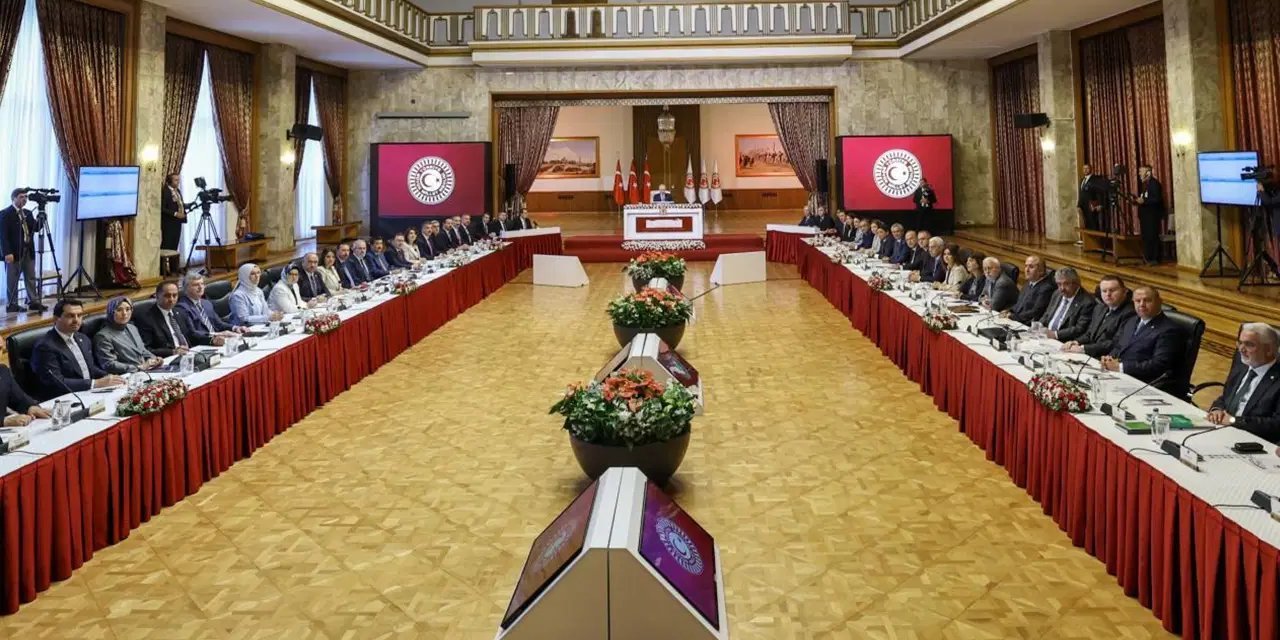
Following the historic visit by PKK–Turkey peace commission delegation to Abdullah Ocalan and its briefing to Turkey’s top security council, a package of parliamentary legal reforms is now expected to be brought forward to finalise the process’s legal framework.
Context: The PKK–Turkey peace commission was created in Parliament to do something previous initiatives never quite managed: design a coherent legal framework that can absorb the PKK’s decision to lay down arms and regulate the fate of its members within a predictable rule-of-law environment. Since early August, the commission has met repeatedly with officials, legal experts and political parties, while each bloc has been quietly drafting its own wish-list of changes.
According to reporting in the Turkish press, all parties represented in Parliament are expected to submit formal proposals on the “democratic and legal steps” required for the process by 28 November.
Analysis: At the core of the emerging architecture are the AKP’s proposals, clustered under what officials call the “Return Home” (Eve Donus) project. The first building block is definitional. The government wants to amend both the Turkish Penal Code (TCK) and the Anti-Terror Law (TMK) to introduce a clear legal category for “terrorist organisations and members who lay down arms.” In other words, the law would explicitly separate those who comply with the disarmament line – as articulated in Ocalan’s 27 February “Peace and Democratic Society” call and the PKK’s subsequent decision to dissolve itself – from those who refuse to disarm or remain in active structures.
Around this, the AKP envisages a framework statute – often described in Ankara as a “kod kanun” – that would set out the purpose, scope and phases of the entire transition. Rather than relying on piecemeal amnesties and ad hoc decrees, the government wants a single, overarching law that explains what the state is trying to achieve, how long the process will last and what the legal limits of leniency will be.
The most politically sensitive question is what happens to the thousands of people already in prison. AKP figures say the package will propose the release of those who “aided and abetted” terrorism, did not personally participate in violent crimes and whose role was largely to defend the PKK and its goals at the level of ideas, speech or political work. For others, the emphasis shifts from outright release to a recalibration of how sentences are implemented. Here, a retooled execution regime (infaz) would kick in, with members able to benefit from existing but newly structured tools such as effective remorse provisions, supervised release and conditional parole, depending on the nature and severity of their offences and their conduct in the disarmament phase.
For those who did not themselves commit crimes and who qualify under these execution arrangements, the AKP is promising more than just open prison doors. The package points to active reintegration policies aimed at bringing former sympathisers and low-level members back into social and economic life, signalling – at least on paper – a shift away from a purely punitive reflex towards a managed “return to civilian life.”
At the top of the organisational pyramid, the proposals are more cautious. The status of senior PKK leaders who want to spend the rest of their lives in Turkey would be treated as a separate file, with “special assessment” language that leaves room for bespoke conditions. Officials hint this could involve more restrictive regimes, clear political red lines or enhanced monitoring, rather than the standard execution rules applied to rank-and-file.
The AKP’s legal vision also extends beyond individuals to the security architecture of Turkey’s southeast. One of the most symbolically charged elements is a plan to gradually phase out the village guard (korucu) system, which has operated in the region for nearly three decades as a state-armed auxiliary force. Dismantling this structure would send a powerful signal that the exceptional “internal war” order is being wound down and could reduce the influence of local armed patronage networks that have long complicated governance.
The CHP, for its part, is trying to ensure that the peace commission’s work does not freeze the moment into a narrow amnesty file. It is preparing to expand the 29-article democratisation package it has already submitted to the commission and is explicit that the final report should not consist solely of legal arrangements linked to disarmament.
In the CHP’s framing, the Anti-Terror Law sits at the heart of the problem. Party lawyers argue that its vague, expansive definitions have allowed prosecutors and courts to criminalise non-violent political activity, journalism and civil society, and that any sustainable peace requires tightening these provisions to restore legal certainty. The opposition ties this directly to a second demand: full implementation of Constitutional Court and European Court of Human Rights judgments. Selective compliance with top-court rulings, CHP officials say, has eroded trust in the judiciary and turned terrorism-related offences into a political weapon.
The party’s package also speaks to the Kurdish municipal experience of the past decade. CHP wants to end the extensive use of state-appointed trustees in place of elected mayors and to restore a robust model of local self-government. Alongside this institutional focus is a push for the release of political prisoners across several categories: those caught up in the “19 March coup attempt” narrative, defendants in the Gezi Park and other protest-related cases, and a broader cohort held on speech and association charges rather than proven violence.
To prevent a return to the status quo, CHP is targeting the cluster of “thought crimes” that have proliferated in recent years. It is calling for reform of the laws criminalising insults against the president and public officials, and of the offence of incitement to hatred. The aim is not to decriminalise everything, but to redraw the line between genuine hate crimes and legitimate political speech, while in parallel providing a more precise framework for prosecuting hate speech and hate-motivated offences so courts are not left to improvise.
Beyond the front-end of criminal law, the party is also looking at what happens after conviction. It argues for a human-rights-oriented execution regime – one that is “compatible with honour” – which would curb arbitrary practices by prison administrations, tighten the rules on anonymous or “secret” witnesses and prevent the abuse of effective remorse clauses as a tool of coerced denunciation. Linked to this is a call to revisit the status of those purged by emergency decrees (KHKs) in the post-coup period, this time under the supervision of proper courts and transparent legal standards rather than through purely administrative fiat.
More broadly, the CHP’s democratisation package includes a push for genuine state neutrality on religion and belief and the creation of a fully independent human rights and equality institution, designed as institutional guardrails against the majoritarian, securitised politics that helped entrench the conflict in the first place.
Around these two heavyweight agendas, other parties are trying to shape the micro-architecture. The MHP, whose deputy Feti Yildiz sits on the peace commission and joined the Imrali delegation, is less focused on political symbolism than on the integrity of the sentencing system. Yildiz has argued that Turkey’s execution law has become a “patchwork” of piecemeal amendments and one-off exceptions and needs to be rewritten from scratch. From the nationalist right’s perspective, a clean, coherent infaz code – applied equally – is the main safeguard against what its base fears as stealth impunity.
The DEM Party, by contrast, sees the commission as a rare opening to hard-wire a more libertarian legal order. Represented on the delegation by MP Gulistan Kilic Kocyiğit, DEM wants Parliament to assume responsibility for locking in whatever gains the process produces through laws that expand civil and political freedoms as far as the political balance will allow. Party figures say the commission should be a forum where even the most far-reaching ideas can be aired, rather than a body that pre-emptively censors itself for fear of backlash.
Within the AKP’s own legal team, there is also an eye on international experience. Justice Committee chair Cuneyt Yuksel has floated the idea of studying the demobilisation and reintegration models used with ETA in Spain and the IRA in Northern Ireland, combined with a comprehensive sweep of existing Turkish legislation and closer alignment with fair-trial guarantees and legal-security standards. The message is that Turkey does not have to improvise in a vacuum; it can borrow from other countries that have demobilised armed movements under democratic rule.
Even beyond the main blocs, smaller parties are joining the debate. The nationalist Vatan Party has submitted its own amnesty proposal aimed at integrating former PKK members into state and society. These drafts may have little legislative weight compared to AKP and CHP texts, but they show how the question of legal status for ex-combatants has already spilled out beyond the walls of the peace commission.
What is now taking shape is less a single “amnesty law” than a layered post-conflict legal regime. One layer, driven by the AKP’s “Return Home” project, focuses narrowly on the mechanics of disarmament: who counts as having laid down arms, how their sentences can be reduced or lifted, how they can be reintegrated and how legacy structures like the village guard system can be wound down. A second layer, championed by the CHP and echoed by other opposition actors, stretches far wider – toward a re-written Anti-Terror Law, strict obedience to top-court rulings, an end to trusteeship in Kurdish municipalities, the release of emblematic political prisoners and a more rights-based approach to how punishment is enforced.


