


Bypassing Its Rival, KDP Seeks New Allies to Break 13-Month Kurdistan Parliamentary Paralysis
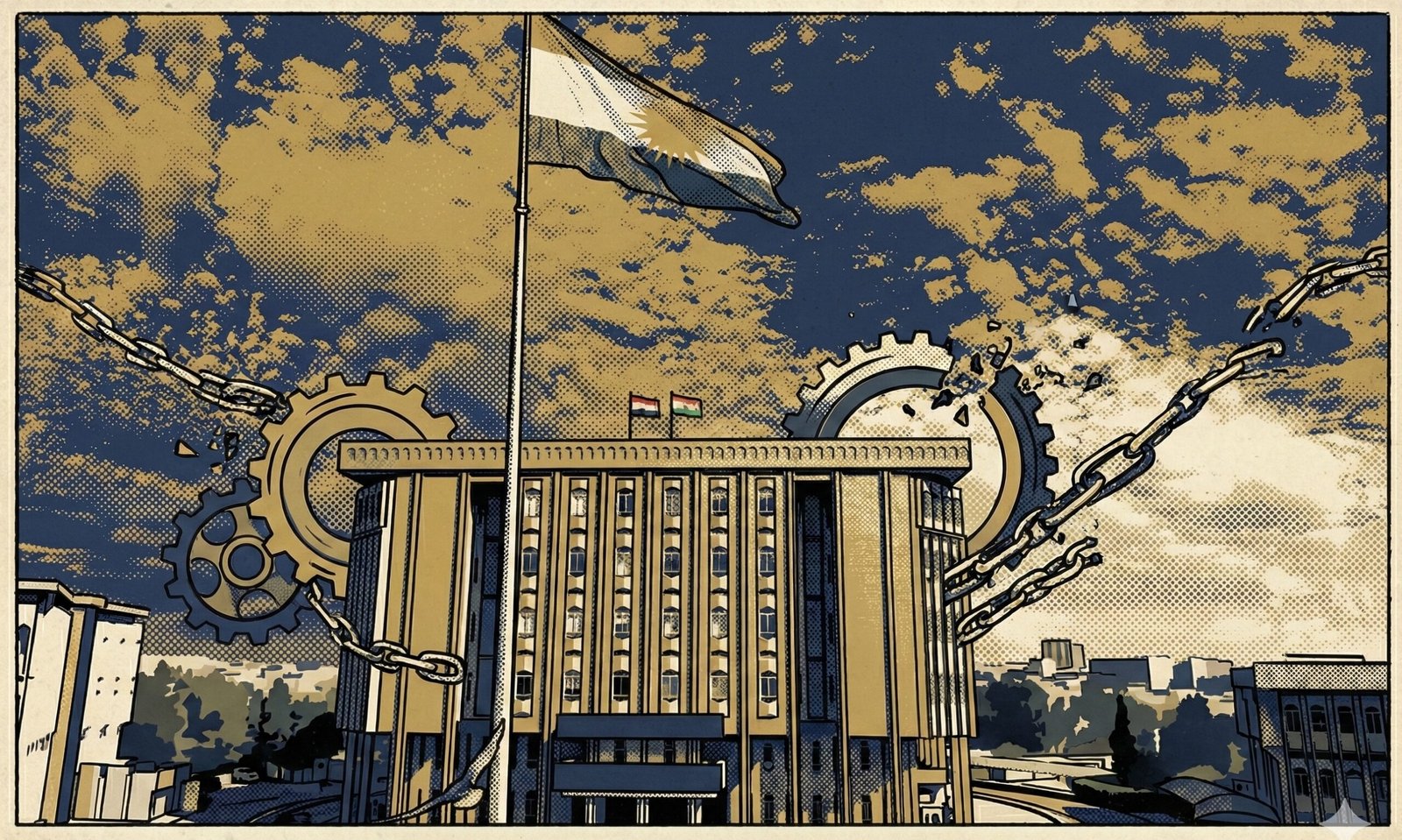
More than 13 months after regional elections, the KDP is aggressively exploring ways to bypass its longtime partner, the PUK, and secure enough votes to form the next KRG cabinet. With Iraqi national elections now concluded, the KDP can fully turn its attention to breaking the deadlock that has paralyzed the Kurdistan Parliament.
Since elections were held on October 20, 2024, parliament has convened only once, in January, and only for members to be sworn in so they could begin receiving salaries. That session was technically kept open because the law requires the parliament speakership to be elected in the first sitting.
The Quorum Question
If parliament reconvenes, the issue of achieving quorum has been resolved. But the KDP wants to go further and secure enough votes to elect the speakership and form a cabinet. To that end, the party has instructed all its MPs to remain in the Kurdistan Region and be ready, signaling active negotiations with smaller parties.
The PUK has said it will attend parliamentary sessions but will neither join nor vote for a government it did not help shape. The main opposition New Generation movement, which holds 15 seats, says it will also attend and is now open to joining the government if it reaches an agreement with the KDP. Halwest will participate in neither parliament nor government. The People’s Front, led by jailed former PUK leader Lahur Sheikh Jangi, will attend.
The PUK does not want this cabinet formed – and certainly not through KDP negotiations with other parties. But the KDP says it will no longer wait and intends to play all its cards.
The Interior Ministry Impasse
The deadlock centers on the distribution of posts. After several rounds of negotiations, the two parties have failed to agree on a formula. The PUK has accepted that the KDP will hold both the prime minister and regional president positions, but insists it must receive the third most important post: the Interior Ministry. The KDP has refused, having controlled that ministry for decades.
The KDP says it would give the PUK seven or eight ministries—including Peshmerga and Finance—as well as the parliament speaker, deputy prime minister, and deputy regional president posts. The PUK has rejected this, remaining fixated on Interior and offering the Peshmerga Ministry to the KDP in exchange.
A key obstacle is that the two parties have failed to establish a systemic formula—such as a points-based system that would distribute posts according to seat share and assigned values. The KDP has rejected such an approach because the prime minister and president posts would consume many points, and between the two parties, the KDP holds 63 percent of the seats to the PUK’s 37 percent.
The Interior Ministry is not just symbolically important. Aside from being arguably the most powerful ministry in the regional government, the Interior Minister sits on Iraq’s High Security Committee and participates in international meetings and Iraqi delegations—a strategic window the KDP is unwilling to relinquish. When Qasim al-Araji, Iraq’s National Security Advisor, visited Iran, Interior Minister Rebar Ahmed was a member of the delegation during which the security situation between the two countries was discussed. According to sources, if the Interior Ministry position were given to the PUK, the party intends for the position to be managed by Qubad Talabani himself, alongside his position as Deputy Prime Minister—a consolidation of power the KDP finds unacceptable.
KDP’s Post-Election Posture
Since the Iraqi elections, the KDP has shifted its tone, claiming that the conditions for government formation that existed before the vote no longer apply. This appears calculated: while the KDP’s seat count actually decreased compared to the 2021 Iraqi elections, the party focused its campaign messaging on surpassing one million votes—a threshold it achieved. The KDP has emphasized this figure rather than seats, framing its standing as improved.
The Iraqi Presidency Complication
Another layer of complexity has now emerged: the Iraqi presidency is now a battleground between the KDP and PUK, and failure to reach consensus could further complicate KRG cabinet formation.
The post has been held by the PUK since 2005. But since the death of PUK founder Jalal Talabani, the KDP has insisted it should rotate to them—and has failed twice to secure it.
Iraq’s ruling Shia parties prefer a consensus Kurdish candidate. But if the KDP and PUK each field separate candidates, the PUK will likely prevail. The KDP remains tethered to the 2017 independence referendum, and its fluctuating relations with Iran make Shia parties wary. Even among Sunnis, the largest bloc—Taqaddum—has poor relations with the KDP and has openly signaled support for a PUK candidate.
The expected candidates reflect this divide: the KDP may field current Iraqi Foreign Minister Fuad Hussein or KRG Interior Minister Rebar Ahmed, while the PUK is reportedly considering Baghdad office head Nizar Amidi or Iraqi minister Khalid Shwani. If each party fields its own candidate, KRG cabinet formation prospects will likely worsen further.
Courting the Smaller Parties
The KDP now wants parliament to convene and the speakership elected by any means necessary. Since the November 11 Iraqi elections, it has contacted other parties and invited them to join the next cabinet.
Halwest, the National Stance Movement, which holds four seats, has decided not to participate in the KRG cabinet and their decision is final. They will become opposition but will participate in the new Iraqi government cabinet.
The Kurdistan Islamic Union, which holds seven seats, has also decided not to participate in the KRG cabinet and their decision is final. However, they are ready to participate in the Kurdistan Parliament session. This completes the quorum for the parliamentary session, but not the quorum for electing the parliament presidency.
The Kurdistan Justice Group, which holds three seats and at the time decided not to go to parliament altogether, may now join parliament but will not participate in the cabinet.
The People’s Front, which holds two seats, will participate in the Kurdistan Parliament session.
That leaves New Generation, with its 15 seats, as the only viable path for the KDP to reach the numbers without the PUK. The KDP has specifically asked New Generation to join the government. Sources from the movement say they are open to the proposal and view it favorably, but want the issue of leader Shaswar Abdulwahid’s imprisonment included in any deal—using government participation as leverage against the PUK to secure his release. Their priority is freeing their leader.
At Friday’s New Generation Movement meeting, members decided: “The movement and whatever decision the movement’s leader makes from prison, everyone will be bound by it.” The dominant direction within the movement is to participate in government, because they believe they can do better work through that path, and the experience of being in opposition no longer satisfies the movement.
However, this is the same argument used by the Gorran movement when it was at the peak of its performance—before joining government failed to yield any tangible reforms and instead led to the collapse of the movement, as its voter base saw them as being co-opted by the KDP rather than keeping their promise of real reform.
According to sources, since the final decision rests with Shaswar Abdulwahid, the council has only presented its recommendations and is waiting for him to have the final say on whether to participate in government or not. Sources from New Generation also say that so far, the KDP has not officially held any meeting with them for that purpose, though there has been contact. At a press conference today, the New Generation faction in the Kurdistan Parliament indicated that they have not decided whether to participate in government or not, and that matter will be resolved by the movement’s leader.
Sources from New Generation also allege that the KDP and PUK, because of their disagreements and tensions, want to use New Generation to pressure each other and obtain maximum demands. According to these sources, first the PUK spread rumors that New Generation parliamentarians had been bought by the KDP, then the KDP spread rumors that they would form the regional government cabinet with New Generation and without the PUK. The source believed that just as those two parties resort to everything to pressure each other for personal gains, they have used the New Generation file in the same way.
The 2019 Precedent and Its Limits
With New Generation’s participation in the next cabinet, there is a possibility of repeating the 2019 experience of forming the ninth cabinet, when the KDP and Gorran Movement together formed the parliament and government presidencies, but left the PUK posts the KDP decided for them vacant—and later the PUK joined the government.
However, the situation since then has changed. The PUK was then in disarray, but now might forcefully push back and block the KRG from operating in its zone in Sulaymaniyah, which it militarily controls. New Generation, which has its headquarters in Sulaymaniyah, may therefore need to tread carefully.
In all cases, with New Generation joining the government, the legal quorum of parliament and the election of presidencies will be complete, and the quorum issue will be resolved. Even if New Generation does not participate in the government cabinet, because they have candidates for the parliamentary presidency board, they will attend the parliamentary session. In that case, the legal quorum of parliament will be complete, but the quorum for electing the presidencies will not be complete, because electing the parliamentary presidency requires 51 votes. Without an agreement between the KDP and another party, the KDP cannot obtain the votes of 51 parliamentarians for electing the parliamentary presidencies, which is the first stage of forming a new government.
The Numbers Game
The KDP wants to complete the legal quorum for electing the presidency board by completing the legal quorum in the parliament hall.
For the legal quorum of the parliamentary session, the KDP holds 39 seats, New Generation holds 15 seats, the Islamic Union holds seven seats, the People’s Front holds one seat (one of their two members has not taken the oath), and three KDP-allied quota seats round out the total. This amounts to 65 parliamentarians, which is much more than the 50+1 legal quorum needed for convening parliament.
However, if the KDP does not have an agreement with one of these parties for government formation, it cannot elect the parliament speaker because electing the speaker, deputy, and secretary requires 51 parliamentarians’ votes. Therefore, the KDP’s problem is not convening the session as much as the problem of electing the presidency board, and later electing the Region President and giving confidence to the Prime Minister.
According to Article 47 of the amended Kurdistan Parliament Election Law No. 1 of 1992, the first session must be held within ten days after the results are certified. According to Article 48 of the same law, in its first session, parliament elects a speaker, deputy, and secretary by absolute majority vote of members. This means half plus one of the number of parliament members—that is, 51 parliamentarians’ votes are needed.
If the KDP agrees with New Generation, the KDP’s 39 seats combined with New Generation’s 15 seats and three KDP-allied quota seats would total 57 seats—a complete legal quorum ratio for electing the presidencies of parliament, the region, and the government. In that case, New Generation might obtain one of the sovereign positions.
The Snap Election Card
The KDP’s second option, if it fails to reach an agreement with any party and fails to reach an agreement with the PUK, is calling for snap elections.
According to Paragraph 4 of Article 10 of the amended Kurdistan Region Presidency Law No. 1 of 2005, the Kurdistan Parliament is dissolved in the following cases. In these four cases, parliament is considered dissolved, and the Region President issues a declaratory decree dissolving parliament: if more than half of the members resign; if within 45 days of being summoned by the Region President, the legal quorum for a session is not achieved; if parliament fails to give confidence to three consecutive cabinets; or if the electoral system changes and less than six months remain in the parliamentary term.
Although dissolving the Kurdistan Parliament may not be difficult and could be done by a decree from the Region President—just as he issued a decree for convening parliament, he could also dissolve parliament under the pretext of not electing the parliamentary presidency within the legal deadline—in reality, dissolving parliament and holding new elections is difficult. The KDP’s threats may only be pressure tactics on other parties to complete the parliamentary legal quorum. Holding new elections would require more than six months, and the Electoral Commission’s term expires next January. Therefore, it is difficult to hold elections under these circumstances.
All signs point toward the Kurdistan Parliament eventually convening, electing its speakership, and choosing a Region President—though the path there remains contested.


