


Iraq’s Customs War Is Quietly Rerouting Trade and Draining Kurdistan’s Gateways
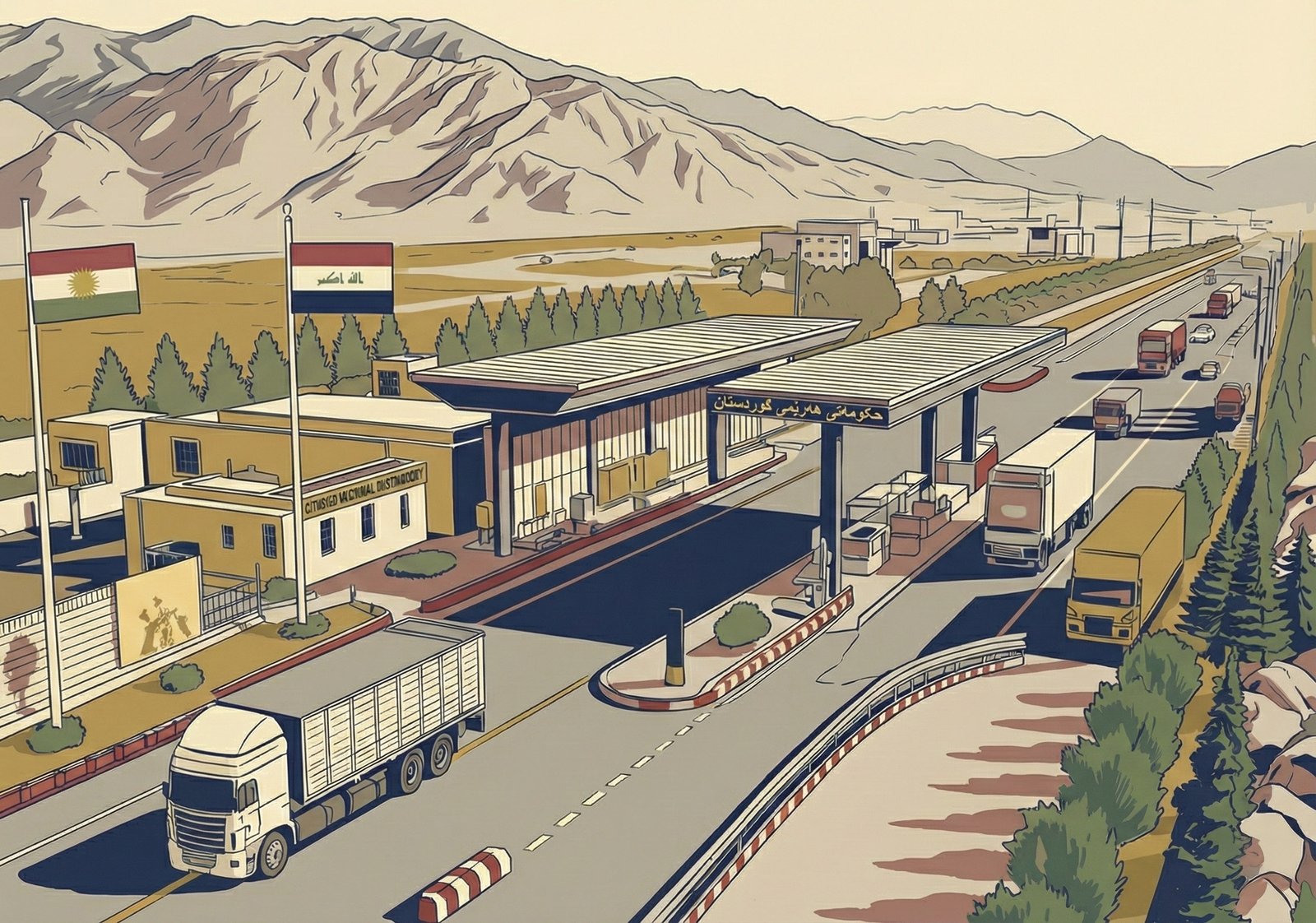
Customs revenue at the Kurdistan Region’s border crossings has collapsed by fifty percent, and traders across northern Iraq now face the punishing reality of paying duties twice on the same goods. With Baghdad’s final deadline for digital customs integration looming at the end of this year, the standoff between the federal government and Erbil threatens to fundamentally alter the economic geography of Iraq, redirecting trade flows that have defined the region’s prosperity for two decades. Goods that once flowed from Kurdistan into the rest of Iraq are now moving in the opposite direction, as merchants abandon the region’s crossings in favour of federal ports to escape a system that has made doing business in the north increasingly untenable.
Context: The customs dispute between the Kurdistan Regional Government and Baghdad is among the most intractable files left unresolved since the fall of the former regime in 2003. What appears on the surface to be a technical disagreement over tariffs and data systems is in reality a struggle over sovereignty, administrative authority, and power.
The roots of the conflict trace back to the immediate post-2003 years, but the issue deepened dramatically in 2014 when Baghdad cut the Kurdistan Region’s budget share. Tensions escalated further following the 2017 independence referendum, when the federal government moved to assert full control over the region’s border crossings. The passage of the tripartite Federal Budget Law covering 2023 to 2025 introduced a legal dimension to the dispute, stipulating that the Kurdistan Region must transfer fifty percent of its non-oil revenues, of which customs duties are the largest component, to the federal treasury.
At the centre of the current crisis is the ASYCUDA system, an acronym for Automated System for Customs Data. Developed by the United Nations Conference on Trade and Development, this computerised customs management platform is used by more than ninety countries worldwide. The system processes imports and exports electronically, with the stated goals of reducing corruption, increasing government revenue, and facilitating trade. Under ASYCUDA, all transactions are recorded transparently and cannot be tampered with. Traders register goods before they arrive, the system conducts automated risk assessments to determine which shipments require detailed inspection and which can pass directly, and tax calculations are performed automatically. Customs procedures that once took days can be completed in hours.
Iraq has begun implementing ASYCUDA at its federal crossings and has demanded that the Kurdistan Region do the same at Ibrahim Khalil, Bashmakh, and Parwizkhan, with all data linked to Baghdad’s central network. The federal government has extended the deadline for compliance three times, with the final extension set to expire at year’s end. The Kurdistan Region has thus far refused to submit to this demand.
Analysis: A trader who brings goods through the Kurdistan Region may pay at the crossing, but then encounters federal checkpoints between the Region and the rest of Iraq, on routes running through Mosul and Kirkuk, where the same goods are charged again because the federal side does not recognize the KRG process as part of the unified system. The direct outcome is higher landed costs that feed through to consumer prices, and a growing incentive to bypass KRG crossings entirely.
What looks like a customs software dispute is functioning as a realignment mechanism for Iraq’s internal economy, because it changes two things at once: the financial viability of the Kurdistan Region’s gateways and the bargaining position of each side in the wider budget standoff. On the economic side, double taxation is not just an inconvenience; it is a structural penalty that forces traders to choose between absorbing losses and passing costs onto consumers. As that burden becomes predictable, investors and importers rationally reroute. That is already visible in the reported 50% drop in customs revenue at Ibrahim Khalil and other KRG crossings, and in the shift of traders toward federal routes, particularly Umm Qasr and other Baghdad-controlled entry points. The knock-on effect is a reversal of the traditional trade pattern: instead of goods entering through the Kurdistan Region and flowing onward into federal Iraq, more cargo is arriving through federal Iraq and then moving north into the Kurdistan Region. For Erbil, that is not merely lost fee income. It is lost strategic leverage, because control over gateways is one of the few non-oil revenue instruments the Region can directly influence.
Baghdad’s pressure is also being reinforced through the currency channel. If KRG traders are outside the recognized customs system, they can be deprived of access to US dollars through the Central Bank of Iraq’s platform at the official rate, a margin that market participants describe as roughly a 7% advantage compared with alternatives. That difference is big enough to decide routing choices in high-volume import businesses. Once access to official-rate dollars is conditioned on compliance, the “choice” to use KRG crossings stops being commercial and becomes financial survival. This is why the deadline matters. If the cutoff at the end of 2025 is enforced, the system would lock in a tilt toward federal crossings, deepen revenue losses at KRG gateways, and accelerate capital migration toward Baghdad-centered supply chains.
Politically, ASYCUDA is attractive to Baghdad precisely because it translates sovereignty into data. A unified electronic record means the center can see what enters and exits, how it is classified, what duties are assessed, and what is collected. That transparency cuts two ways. It can reduce corruption and leakage, but it also constrains the autonomy that the Kurdistan Region has historically exercised at its borders. Non-oil revenue sharing has long been one of the most contentious files between the KRG and Baghdad, and a persistent federal allegation is that Erbil has underreported real non-oil revenue to minimize what it must share. From that perspective, an electronic system that makes concealment harder is not a neutral modernization project; it is a redistribution tool. For Erbil, the fear is not only oversight, but loss of discretion over exemptions, procedures, and the informal arrangements that often accompany revenue collection in a fragmented state.
Baghdad’s push is also moving beyond software and toward a collection model that would bypass KRG control even if inspections remain local. One proposal now being pressed on the Region is a “prepaid customs” arrangement under which traders using KRG border gates would pay duties in advance into an Iraqi bank account. In practical terms, that would pull Ibrahim Khalil’s customs revenue out from under Erbil’s finance system and recast the border gate’s role from a point of collection to a point of verification, with the crossing reduced largely to inspection and clearance of goods. For the KRG, this is why the dispute is not simply about harmonising tariffs or modernising procedures; it is about whether the Region keeps a core lever of fiscal autonomy at its most strategic gateway, or whether Baghdad can rewire the cashflow first and argue about technical integration later.
The dispute is also becoming a recurring instrument in the salaries-for-revenue cycle. Federal audit reports have argued that lack of coordination wastes billions of dinars in public revenue, and Baghdad routinely uses that narrative to justify conditioning salary transfers on the handover of border income. Erbil, in turn, treats salary delays as political punishment and argues that Baghdad is not meeting the Region’s entitlements under the budget framework. ASYCUDA escalates this cycle because it produces a binary compliance test. Either the KRG crossings are linked and revenue is visible to Baghdad, or they are not, and traders and public employees become the immediate pressure points.
There is a further dimension that is being under-discussed but matters to citizens: standards and health. Supporters of Baghdad’s push argue that tighter federal control and unified digital processing can curb smuggling and standardise enforcement, but the quality-control picture is not one-directional. On some checks, the Kurdistan Region’s procedures are more robust than Baghdad’s. Frozen meat is a useful example. In the Kurdistan Region, inspectors can require longer, more demanding checks tied to defrosting and storage conditions over extended periods, while federal entry points may rely on shorter inspections. The point is not the single commodity, but the unevenness itself. When tariff and inspection regimes diverge, traders route cargo through whichever crossing offers the easier mix of cost and scrutiny, and consumers absorb the risk. This is why the customs dispute is not only about revenue and sovereignty; it is also about who sets standards, how consistently they are enforced, and whether a unified system will raise compliance everywhere or simply shift control without fixing the gaps.
None of this means the dispute is unsolvable on paper. But the core problem, and the reason the dispute is escalating now, is that the customs file is not primarily technical. It is a power struggle over borders, data, and the Region’s economic lifeline, with smuggling networks, party interests, and patronage systems sitting in the background. That is why a system built to reduce corruption and speed up trade is instead producing a trade squeeze. The costs are being socialized onto traders and consumers through double taxation and higher prices, while the benefits are being contested as political leverage. If no agreement is reached by 31 December 2025, the likely short-term outcome is not administrative “order,” but a sharper contraction in KRG customs revenue, a deeper shift of imports toward federal crossings.


