


Iraq Posts 8.8 Trillion Dinar Deficit in First Nine Months of 2025 as Wage Bill and Pensions Surge
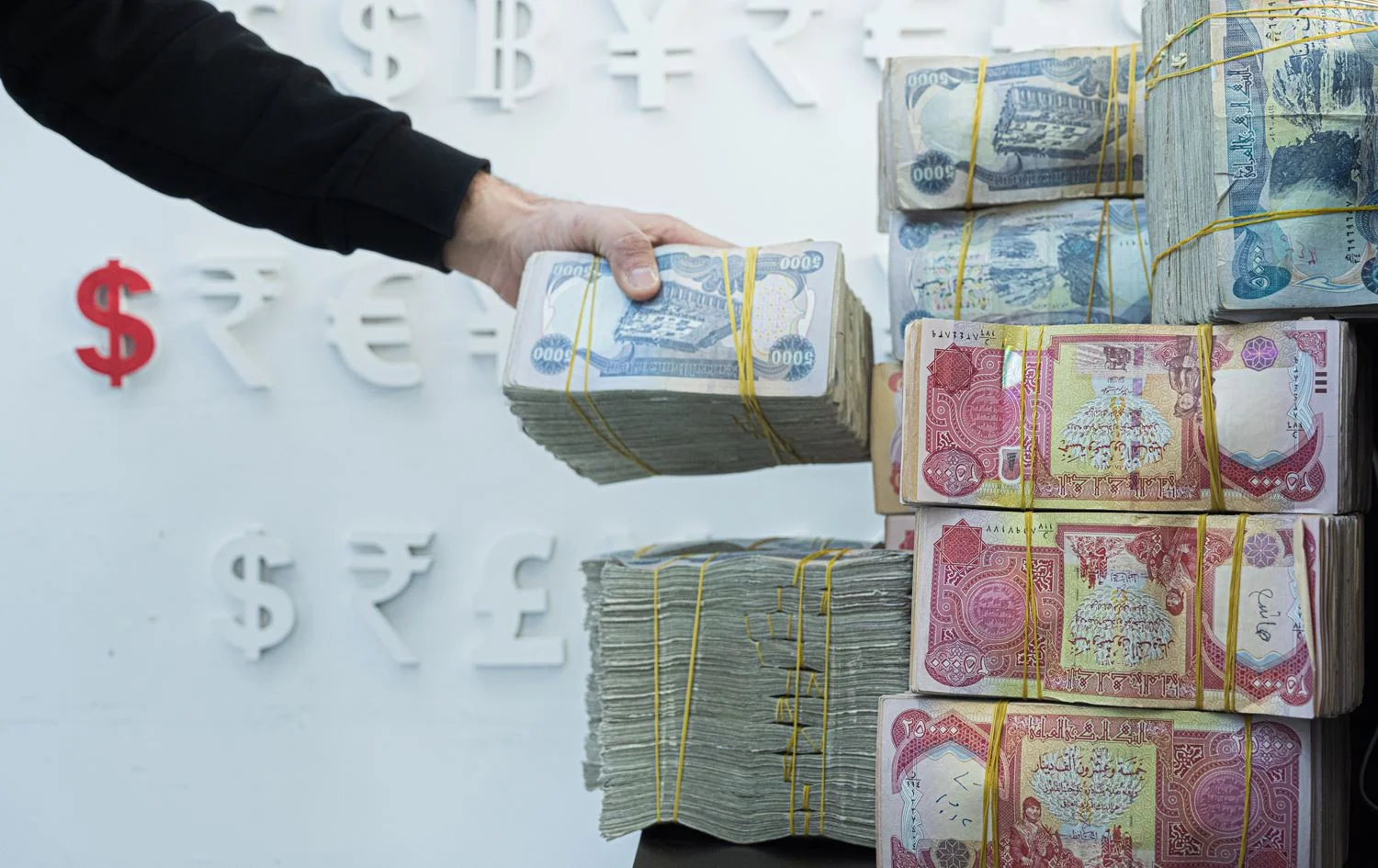
Iraq’s Ministry of Finance close the first three quarters of 2025 with a budget deficit of 8.81 trillion dinars, as total government expenditure of 99.98 trillion dinars outstripped revenues of 91.17 trillion dinars by around 10 percent, according to official monthly reports released by the ministry
Revenue: Oil Dominance Continues
Total revenue reached 91.17 trillion dinars, with oil accounting for 89 percent (81.75 trillion dinars) and non-oil sources contributing 11 percent (9.42 trillion dinars).
Oil revenues came primarily from crude exports (66.05 trillion dinars), followed by proceeds from the Chinese framework agreement (8.91 trillion), licensing round payments (4.53 trillion), petroleum products (1.71 trillion), and the treasury’s share of oil-sector profits (544 billion).
Non-oil revenues included income taxes (2.52 trillion dinars), commodity taxes and production fees (1.87 trillion), the treasury’s share of public-sector profits (1.08 trillion), transfer revenues (1.27 trillion), fees (791 billion), and capital revenues (173 billion). The Kurdistan Region contributed 679 billion dinars in non-oil revenue transfers to the federal treasury.
Monthly revenue peaked in June at 15.85 trillion dinars — driven by exceptional oil intake of 15.12 trillion — before declining to 8.79 trillion by September.
Expenditure: Wages and Welfare Dominate
Government spending totalled 99.98 trillion dinars, split between operational expenditure (85.48 trillion, 89 percent) and capital investment (14.50 trillion, 11 percent).
The public-sector wage bill and social transfers consumed the bulk of spending. Employee compensation alone reached 45.56 trillion dinars — nearly half of all expenditure. Pension payments added another 14.18 trillion dinars, while the social protection network cost 4.26 trillion and the public distribution system (food ration cards) absorbed 1.97 trillion. Grants, wages and salaries totalled a further 3.60 trillion dinars. Combined, salaries and social welfare payments reached 66.54 trillion dinars — roughly two-thirds of total government spending.
Other major current expenditure categories included debt servicing (5.86 trillion dinars), electricity costs (3.53 trillion), grants and subsidies (8.96 trillion), commodity requirements (4.74 trillion), wheat purchase support for farmers (2.00 trillion), medicine procurement (383 billion), and asset maintenance (194 billion).
Ministry Spending
The Ministry of Finance recorded the highest expenditure at 19.28 trillion dinars, largely reflecting debt service and transfer payments rather than its own operational costs. The security ministries followed: Interior (10.19 trillion) and Defence (6.34 trillion) together spent 16.53 trillion dinars.
The Oil Ministry’s 8.95 trillion dinar expenditure was overwhelmingly investment-focused (8.91 trillion), funding extraction and infrastructure projects. Education spent 8.85 trillion dinars, Health 5.72 trillion, and Electricity 5.60 trillion — the latter reflecting both operational costs and major capital investment (626 billion).
The Council of Ministers recorded 6.61 trillion dinars in expenditure, Labour and Social Affairs 4.84 trillion (driven by welfare disbursements), and Trade 4.01 trillion (largely public distribution system costs). Higher Education and Scientific Research spent 2.30 trillion dinars.
Other notable ministry expenditures included Construction, Housing and Municipalities (1.08 trillion), Industry and Minerals (637 billion), Justice (658 billion), Water Resources (304 billion), Planning (124 billion), and Agriculture (140 billion).
Investment Spending
Capital investment totalled 14.50 trillion dinars across five sectors. Industry dominated overwhelmingly at 66 percent (9.64 trillion dinars), driven almost entirely by the Oil Ministry’s 8.91 trillion allocation to extraction projects. Roads, buildings and services followed at 21 percent (3.04 trillion), transport and communications at 8 percent (1.19 trillion), education at 4 percent (510 billion), and agriculture at just 1 percent (127 billion).
Investment spending was classified by type: the core investment programme absorbed 12.11 trillion dinars, regional development received 2.17 trillion, projects under the Chinese framework agreement took 328 billion, the poverty reduction strategy 42 billion, and border crossings 6 billion. Licensing round-related investment totalled 8.55 trillion dinars.
July emerged as an outlier month, with total spending surging to 20.62 trillion dinars — more than double the monthly average. Investment that month hit 9.12 trillion dinars (44 percent of July’s outlay), with 8.54 trillion flowing to industry alone — representing 89 percent of the sector’s entire nine-month allocation.
Governorate Allocations
Among the 15 governorates (excluding the Kurdistan Region), Baghdad received the largest allocation at 607 billion dinars, followed by Basra (552 billion), Karbala (496 billion), Anbar (490 billion), and Nineveh (315 billion).
Mid-tier allocations went to Diwaniyah (294 billion), Najaf (270 billion), Babylon (257 billion), Diyala (200 billion), and Maysan (191 billion). Smaller allocations were recorded for Wasit (161 billion), Dhi Qar (151 billion), Muthanna (91 billion), Salah al-Din (69 billion — notably receiving zero investment funds), and non-ministry-linked departments (436 billion).
Investment spending varied significantly by governorate. Baghdad’s 505 billion dinar investment allocation was the highest, followed by Karbala (401 billion), Anbar (262 billion), Nineveh (196 billion), Diwaniyah (182 billion), and Najaf (166 billion). Several governorates received minimal investment: Salah al-Din recorded zero, while Muthanna received just 34 billion.
Kurdistan Region Funding
Federal transfers to the Kurdistan Regional Government totalled 8.33 trillion dinars, classified entirely as operational expenditure with no investment component. The allocation comprised 6.24 trillion dinars (74.5 percent) for civil servant salaries, 2.09 trillion (25 percent) for social welfare, and 7.6 billion (0.1 percent) for grants.
Monthly transfers ranged between 1.03 and 1.08 trillion dinars, with no data recorded for June. Salary disbursements remained stable at 770–787 billion dinars per month, while social welfare payments grew modestly from 242 billion in January to 271 billion by September.
In return, the KRG transferred 679 billion dinars in non-oil revenues to Baghdad — 8.15 percent of the funds it received. These payments rose from approximately 50 billion dinars per month in the first four months to a fixed 120 billion from May onward (excluding June).
Three Presidencies
Combined spending by Iraq’s three presidency institutions reached 7.09 trillion dinars. The Council of Ministers accounted for 6.61 trillion (93.1 percent), split between 5.90 trillion in operational costs and 711 billion in investment. The Council of Representatives spent 450 billion dinars with virtually no investment — just 176,000 dinars — while the Presidency recorded 37 billion dinars, including 219 million in investment.
Judiciary and Independent Bodies
The Supreme Judicial Council spent 354 billion dinars, the Council of State 4.3 billion, and the Federal Supreme Court 4.8 billion. The Federal Revenue Allocation Monitoring Commission recorded 1.1 billion, while the Military Industrialization Authority spent 123 billion — almost entirely (116 billion) classified as grants and subsidies.
Budget Advances
The ministry reported outstanding budget advances of 2.23 trillion dinars on a net basis. Current budget advances stood at 1.19 trillion dinars (creditor position), while investment budget advances reached 3.42 trillion (debtor position).


