


KRG Cabinet Formation Deadlock Passes 653 Days, Longer Than Brussels or Belfast
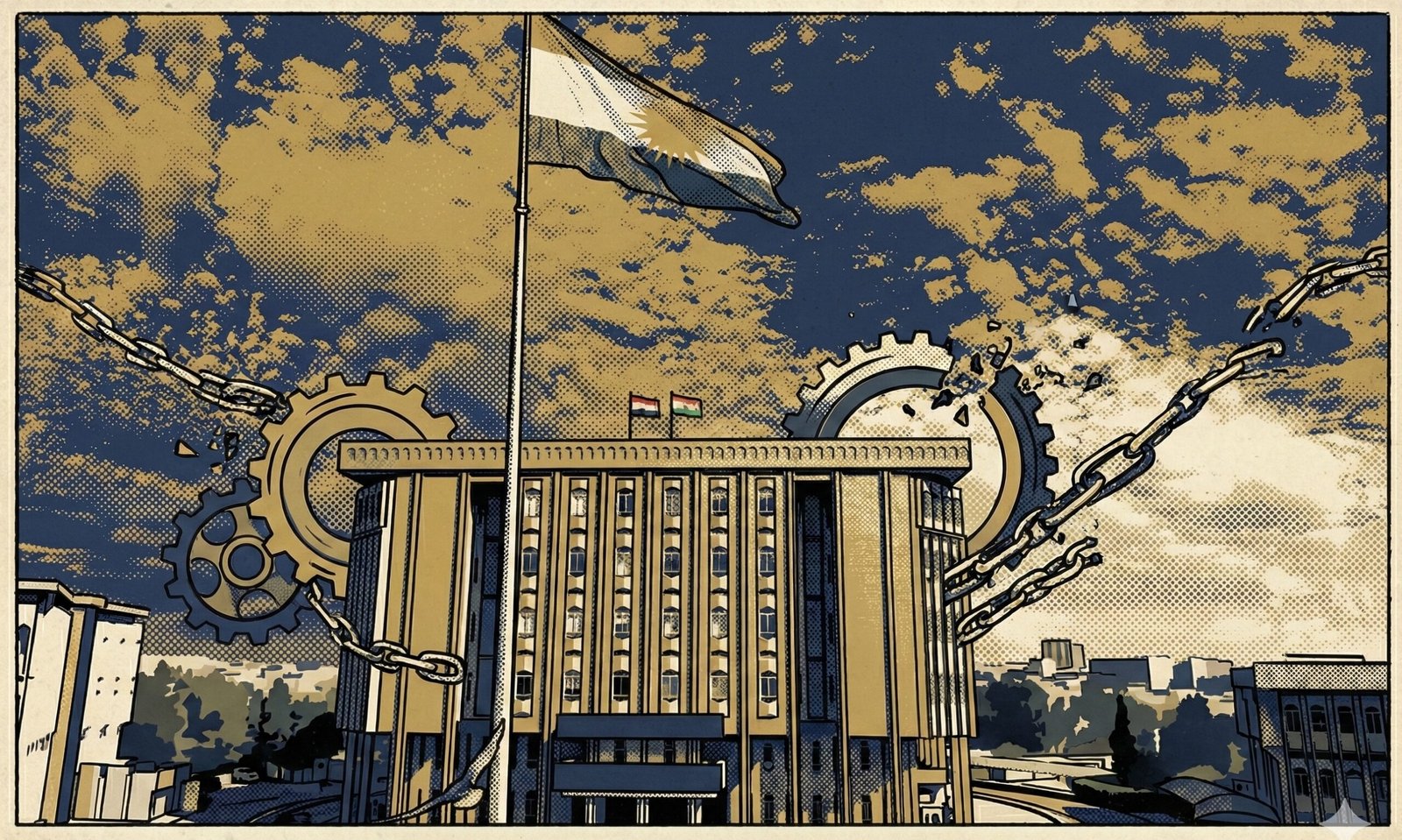
Six hundred and fifty-three days have passed since the Kurdistan Region’s parliamentary elections on 20 October 2024, and the tenth cabinet has still not been formed. The figure exceeds every case normally cited as the outer limit of coalition formation. The Brussels-Capital Region seated its government 613 days after the June 2024 vote, ending a stalemate that had drawn comment across Europe. Northern Ireland took 639 days between the May 2022 Assembly election and the restoration of the executive at Stormont in February 2024. Belgium’s federal record of 541 days, set after the 2010 election, has been passed by nearly four months.
Two features distinguish the Kurdistan case from those comparisons. The first is that the ninth cabinet has continued to govern with undiminished authority. It has concluded agreements and issued decisions carrying long-term fiscal consequences, and it has not accepted the caretaker designation that would confine it to daily affairs. Baghdad supplies the direct precedent. In ruling 213/Federal/2025, the Federal Supreme Court held that the outgoing federal government assumed caretaker status on 11 November 2025 and from that date could take no strategic decisions and enter no long-term commitments. No comparable determination has been sought or applied in Erbil.
The second is the parallel paralysis of the legislature. Parliament convened once, on 3 December 2024, for members to take the oath of office, the procedural step that also starts their salaries. It has not sat since. The chamber has no elected leadership, and the committee system that would depend on it has never been constituted.
Context: The explanation lies in what the Region’s institutions actually do. Parliament, the presidency and the council of ministers form a formal layer above an administrative order run by two parties along territorial lines. Decisions of consequence are taken inside the KDP and the PUK, and the institutions register the outcome afterwards.
The precedent is recent enough to be instructive. In 2015, when an opposition-led parliament moved to address the expiry of Masoud Barzani’s presidential term, the KDP barred the speaker from entering Erbil and the chamber did not convene for nearly three years. The obstruction had no precedent and it held, because the party controlled the ground on which the institution sat and the institution had no independent means of asserting itself. The same mechanism is now operating with the roles partly reversed.
The PUK’s position has strengthened for structural reasons. Authority inside the KDP is concentrated in the Barzani family, which narrows the range of interlocutors with whom any agreement can be made and raises the stakes of each concession. In the PUK zone, gas has meanwhile become the Region’s decisive energy asset. The Khor Mor field in Chamchamal, Sulaimani province, reached 750 million standard cubic feet per day of capacity after the KM250 expansion came online in October 2025, and it fuels roughly 80 per cent of the Kurdistan Region’s electricity generation, Erbil and Duhok included. The suspension of production in February 2026 and the gradual restart announced at the end of July showed how completely the Region depends on a single installation sitting on PUK-held ground. Oil export revenue remains the KDP’s instrument, and gas now provides a counterweight to it.
Analysis: Beneath the energy question, the two administrations are separate at nearly every level.
Each party maintains its own intelligence, security and counter-terrorism services, with distinct chains of command and no unifying structure between them. Fuel supply follows the same division. Each side operates its own refining and distribution arrangements under its own pricing rules, the PUK covering Sulaymaniyah along with the portions of Erbil and Kirkuk provinces it holds, and the KDP covering Erbil and the parts of Nineveh under its control.
Revenue collection has followed the same logic. Rather than channel customs receipts and internal revenue through KRG institutions where the other side could audit them or claim a share, each party has built parallel structures of private companies to collect them. The practice reaches down to routine regulatory functions. Mandatory lift inspections in commercial buildings, to take one example, are carried out by a different private company in each zone, with the fees accruing to that company.
What has emerged are two entities that fuse political, economic, security and social functions in a single structure, each with its own territory and its own captive market.
The absence of external pressure completes the picture, and it follows from a change in American priorities. The National Security Strategy issued in November 2025 removed governance quality, human rights conditionality and nation building from the list of US interests in the region, and committed Washington to accepting the region and its leaders as they are. What remains at the centre of American policy is energy cooperation, economic corridors and partnership with local counter-terrorism actors.
In each of those three areas, the KDP and the PUK have functioned as separate counterparties for years. Energy production and export run through arrangements each side controls on its own ground. Counter-terrorism cooperation runs through two intelligence services with independent chains of command, both holding long-standing relationships with US agencies that predate the current deadlock. Commercial and industrial capacity is organised inside each zone. A unified regional cabinet is therefore not a precondition for anything Washington now wants from the Kurdistan Region, and its continued absence imposes no cost on the American agenda. Where external actors once treated a functioning KRG as a shared interest and pressed for one, they now transact directly with whichever party controls the relevant asset.
Parliamentary arithmetic has contributed as well, at a lower order of importance than the energy shift or the change in American priorities. The KDP’s 39 seats leave it short of the numbers needed to convene the chamber and install its leadership without partners, and the PUK’s alignment with New Generation has given the second party a blocking position it did not previously hold. That arithmetic lowers the cost of waiting for the PUK and closes the procedural route by which a determined plurality might otherwise have forced the question.
Read against that structure, the length of the deadlock becomes explicable. A cabinet agreement would redistribute posts and budgets that both parties already control directly through their own institutions, which raises the cost of conceding while nothing outside the Region raises the cost of waiting. The functions a regional government would perform are being performed elsewhere, which is why the executive can pass 653 days without formation while the Region continues to operate. The cost falls on the institutions meant to bind the two administrations into a single government, and on the citizens whose only recourse against either party runs through them.


